
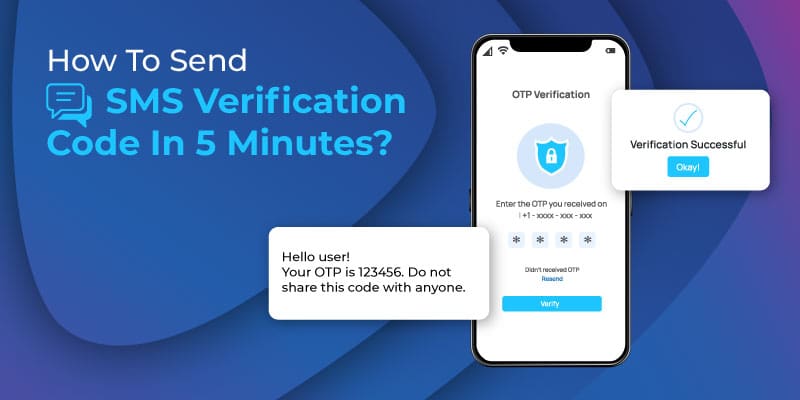
Sending SMS verification codes through SMS is a highly effective, secure, and popular way to verify user identifications.
According to Juniper Research, total SMS traffic used for sending OTP SMS will hit 2.5 trillion by 2028.
SMS OTP verification is widely used across applications for different use cases, including user identity authentication, login protection, password reset, and transaction confirmation.
Integrating a verification process into your business through SMS with extraordinary open rates and the fastest response rate saves you a lot of time, effort, and resources.
Not to mention, it empowers a more secure environment for your customers to exchange information and helps you build trust.
In this blog, we introduce you to the process of sending SMS verification and how to collaborate with the best SMS OTP verification service provider, like Route Mobile, to leverage their expertise, experience, and infrastructure for the best outcomes.
What is SMS OTP Verification?
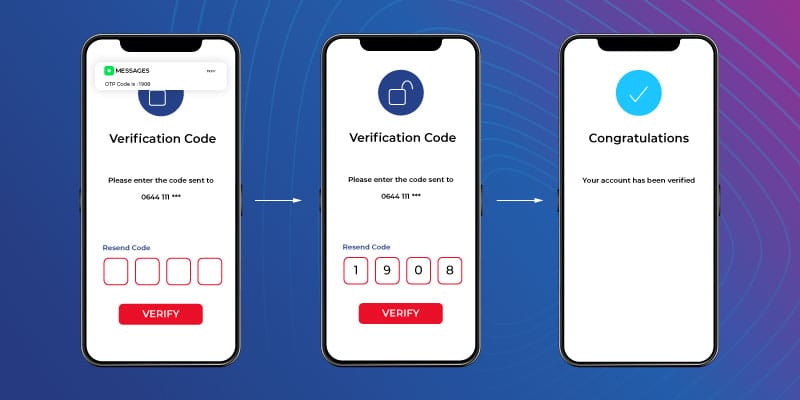
SMS OTP (One‑Time Password) verification is a simple and widely used way to confirm a user’s identity using their mobile phone number. When a user tries to log in, sign up, reset a password, or approve a sensitive action, they receive a unique, time‑bound code via SMS that must be entered to proceed.
Unlike passwords, OTPs are generated dynamically and expire within minutes, which makes them much harder to reuse or exploit. This is why SMS OTP is commonly used as an extra layer of security either on its own or as part of two‑factor authentication (2FA).
Because SMS works on almost every mobile phone and does not require an internet connection, SMS OTP remains one of the most accessible verification methods worldwide, especially across emerging markets and regions with varied network conditions. When implemented correctly, it offers a practical balance between user convenience and security.
Pros and Cons of SMS OTP Verification
Here are some pros and cons of SMS OTP verification:
Pro:
Mobile SMS OTP verification provides optimum security through OTP and other verification methods.
Compared to other 2-factor authentication methods, implementing SMS-based authentication is much more cost-effective.
Many businesses across various applications use SMS OTP verification. Over time, users are now familiar with entering verification codes via SMS, so it is a much more user-friendly authentication method than others.
Cons
When a user loses their device, they get locked out, further compromising their security, especially if the device is found by others or stolen.
Even though SMS authentication is a popular choice for verification, it still has security vulnerabilities and risks.
Users with synced devices can access their messages on multiple devices, making OTPs vulnerable to interception.
How Does SMS OTP Work?
At a high level, SMS OTP verification follows a straightforward flow:
1. User initiates an action
This could be logging in, signing up, resetting a password, or confirming a transaction.
2. System generates an OTP
A one‑time numeric or alphanumeric code is generated.
The code is valid only for a short time window (usually 30–300 seconds).
3. OTP is sent via SMS
The SMS is delivered to the user’s registered mobile number using an SMS API or messaging platform.
4. User enters the OTP
The user inputs the received code on the website or app.
5. System verifies the OTP
If the code matches and hasn’t expired, the action is approved.
If not, the request is rejected or retried with limits in place.
Common Use Cases for SMS OTP Verification
SMS OTP plays a critical role across industries where speed, reliability, and security are non‑negotiable.
Banking & Fintech
Banks and digital finance platforms use SMS OTPs to secure logins, approve transactions, and verify new users during onboarding. Reliable OTP delivery helps prevent fraud while maintaining a smooth customer experience.
eCommerce & Marketplaces
OTP verification is commonly used during checkout, account creation, and high‑value purchases. Fast delivery reduces cart abandonment and improves conversion rates.
Digital Wallets & Payments
Payment platforms rely on OTPs to authorise transfers, bind devices, and add an extra layer of protection to user accounts.
Healthcare & Insurance
OTP verification ensures secure access to patient portals and sensitive personal data, while remaining easy for users of all technical skill levels.
Prerequisites For Sending SMS OTP Verification
To send SMS OTP verification for your business, you will require the following:
- SMS API service providers and specialised solutions for OTP verifications like Route Mobile’s Route OTP
- API Key and Token
- Business Phone Numbers
- Verified SMS service
How To Send SMS Verification Code In 5 Minutes?
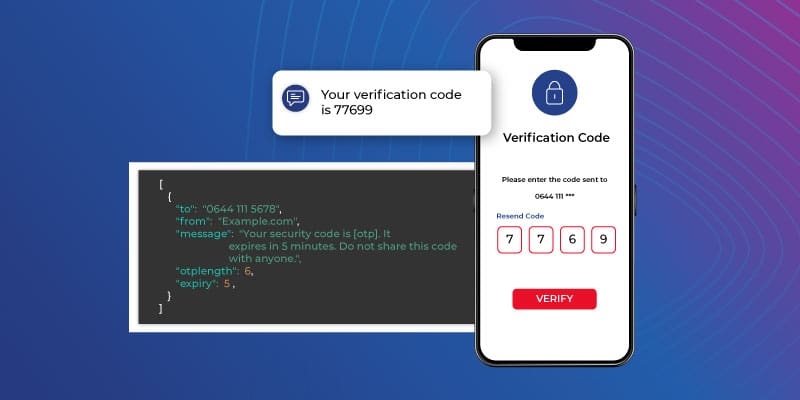
You can send an SMS text verification code through API integration through these steps:
- Pick a coding language from .NET, Ruby, PHP, JavaScript, Python, and Java. Use GitHub or a Zip file to view the code.
- Now, use your API key.
- Finally, you can set up the code sample locally.
Alternatively, you can use a third-party SMS verification service provider to simplify things and leave things to experts with a more user-friendly interface, extensive range of features, and support.
To get started with sending SMS verification codes in 5 minutes, businesses need to collaborate with Route Mobile for their verified SMS service :
- Set up your account with Route Mobile to access the verified message service.
- Business can configure their SMS verification messages, including the content, i.e., OTP and other branding elements.
- Enterprise can send SMS verification codes to user’s mobile devices through the dashboard.
- Route Mobile’s comprehensive suite of solutions also allows businesses to track the delivery status of their verification SMS along with the performance reports of their SMS campaigns.
SMS OTP Security: Risks and Best Practices
While SMS OTP remains one of the most widely adopted authentication methods, its effectiveness depends on how securely it is implemented. Without the right safeguards, it can be vulnerable to evolving fraud tactics. Common risks include:
SIM swapping attacks
Fraudsters exploit social engineering or insider threats to take control of a user’s phone number, enabling them to intercept OTPs and gain unauthorised access to accounts.
SS7 vulnerabilities
Weaknesses in legacy telecom signalling protocols can be exploited to intercept SMS traffic, particularly in cross-border scenarios, posing risks to OTP delivery integrity.
OTP brute-force attempts
Automated scripts repeatedly submit OTP combinations to bypass authentication layers, especially when proper limits or validation checks are not in place.
How Route Mobile helps mitigate these risks
Route Mobile combines telecom-grade infrastructure with built-in security controls to ensure OTP delivery remains both reliable and secure:
Time-bound OTPs
Short expiry windows minimise the opportunity for interception and misuse, ensuring codes remain valid only for a limited duration.
Rate limiting and retry controls
Intelligent throttling prevents repeated OTP requests or verification attempts, reducing the risk of brute-force attacks and system abuse.
Real-time traffic monitoring
Continuous monitoring and anomaly detection help identify suspicious patterns, enabling proactive fraud prevention.
Operator-grade routing and compliance
Direct operator connections and adherence to regional regulations ensure secure message delivery, reducing exposure to vulnerabilities in third-party networks.
When combined with smart controls, SMS OTP remains a secure and trusted verification method at scale.
Also Read: 6 Reasons To Why Opt Verified SMS For Secured & Trusted Business Communication
Route Mobile SMS Verification Number: Sender IDs, Short Codes & Long Codes
When implementing SMS OTP authentication, the type of sender ID used plays a critical role in both deliverability and user trust. Choosing the right format ensures messages reach users reliably while reinforcing brand credibility.
Key sender ID types:
Alphanumeric Sender ID
Displays your brand name (e.g., RouteMobile) instead of a number. This improves brand recognition and trust, especially for one-way communications like OTPs. However, in many markets, replies are not supported.
Short Codes
Typically 4–6 digit numbers designed for high-volume messaging. Short codes offer high throughput, fast delivery, and strong reliability, making them ideal for large-scale OTP use cases. They also often support two-way communication, depending on regulations.
Long Codes (Virtual Long Numbers)
Standard mobile numbers used for messaging.
These are better suited for lower-volume or conversational use cases, but may face filtering or throughput limitations for OTP traffic in certain regions.
Why sender IDs matter for OTP
Improved deliverability
Using the appropriate sender ID aligned with local regulations increases message acceptance and reduces the risk of filtering.
Enhanced user trust
Recognisable sender IDs reassure users that the OTP is coming from a legitimate source, reducing drop-off during authentication.
Regulatory compliance
Sender ID requirements vary by country. Using compliant formats ensures consistent delivery across regions, especially in emerging markets.
SMS OTP vs Other Verification Methods
| Verification Method | How It Works | Key Advantages | Limitations | Best Used For |
| SMS OTP | A one-time code is sent to the user’s mobile number via SMS | Wide global reach, fast delivery, works on all phones, no internet required | Susceptible to SIM swap and signalling attacks if not secured | Banking, fintech, eCommerce, onboarding, transaction verification |
| WhatsApp OTP | OTP is delivered via WhatsApp message | Rich UI, higher engagement, read receipts | Requires data connection and WhatsApp availability | Markets with high WhatsApp adoption, conversational flows |
| Voice OTP | OTP is delivered via an automated voice call | Accessible to non‑text users, useful as fallback | Slower than SMS, higher cost | Accessibility use cases, backup verification |
| Email OTP | OTP is sent to the user’s email address | Low cost, no phone dependency | Slower delivery, spam filtering, inbox dependency | Low‑risk logins, secondary verification |
| App‑based Authenticator | OTP generated within an app (e.g. TOTP) | High security, offline usage | Requires app setup, higher user friction | High‑security enterprise or internal systems |
How To Choose An SMS OTP Service Provider?
Here are a few factors that you should look for when choosing an SMS OTP service provider:
Offer Scalability
Ideally, you would want to hire a service provider to accommodate your current goals and aspirations and match your scaling trajectory without compromising other aspects.
Must Provide Exceptional Support
You will need instant assistance from your service provider whenever something goes wrong. And when their support lacks conviction, your business will face challenges consuming your valuable time, effort, and money.
Must Be Fast And Reliable
The business you choose must be able to deliver SMS verification codes quickly. Also, a service provider you can entirely rely upon, or else it can negatively impact your customer experience.
Ensure Security
The purpose of verification SMS is security, so if the verification service providers are not compliant with Systems and Organisational Controls 2 (SOC 2), i.e., the gold standard for data security, then SMS verification becomes irrelevant. Not to mention exposing unprotected messages to cyber attacks.
Offer Versatile Verification Options
Not all users prefer using the SMS verification feature, so the service provider must be able to provide services for alternate verification options such as Time-based One-Time Passwords (TOTP), email, etc.
Very few SMS OTP verification service providers can meet such expectations. Route Mobile is amongst the top considerations, a leading cloud communication service provider with industry experience in business communication through SMS and other channels as well.
Why Route Mobile for OTP SMS?
Route Mobile supports OTP messaging at scale by combining operator‑grade connectivity, global coverage, and security‑first design. What sets Route Mobile apart:
- High delivery success rates through direct carrier connections
- Global reach across key markets with local compliance support
- Enterprise‑grade uptime SLAs for mission‑critical traffic
- Multi‑language API support (.NET, Java, Python, PHP, Node.js)
- Advanced fraud detection and traffic monitoring
- Flexible sender options including sender IDs, short codes, and long codes
This makes Route Mobile well‑suited for businesses that rely on OTPs for authentication, payments, onboarding, and account protection.
Conclusion
Following these steps, you can start sending SMS verification codes, provided you secure all the prerequisites. More than anything, the SMS verification service provider you choose impacts the efficiency and streamlining of this service for your business.
Ensure you opt for a reliable, trusted, and reputed partner, like Route Mobile, who offers a comprehensive suite of products and services, including SMS API, Voice API, WhatsApp Business API, sender verification, and more. Contact our expert team to get started with sending an SMS verification code today!
FAQs
What is an SMS OTP service?
An SMS OTP service is a messaging solution that sends one‑time passwords to users via SMS to verify identity during logins, transactions, or sensitive actions. The OTP is valid for a short time and can be used only once.
What is an SMS verification number?
An SMS verification number is the sender identity used to deliver OTP messages. This can be a sender ID, short code, or long code, depending on the region, use case, and regulatory requirements.
How do I send an OTP via SMS?
You can send an OTP via SMS by integrating an SMS API into your application or by using a messaging dashboard provided by an OTP service provider. The API approach is ideal for automation, while dashboards suit non‑technical teams.
Is SMS OTP secure?
SMS OTP is secure when implemented with best practices such as short expiry times, rate limiting, monitoring, and fraud detection. Many businesses also combine SMS OTP with additional verification layers for higher‑risk actions.
How long should an SMS OTP be valid?
Most OTPs are valid for 30 to 300 seconds, depending on the use case. Shorter validity windows help reduce the risk of misuse while keeping the user experience simple.