Table of Contents:
- What is WhatsApp Marketing?
- Types of WhatsApp marketing templates businesses can use
- How does WhatsApp marketing API improve marketing performance?
- Understanding WhatsApp marketing message categories and pricing
- Choosing the right WhatsApp message template for your business goals
- Why does WhatsApp marketing matter in 2026?
- How does WhatsApp marketing work?
- Steps To Create A Winning WhatsApp Marketing Strategy
- WhatsApp marketing strategy checklist
- Top Strategies for WhatsApp Marketing
- How to optimize your WhatsApp Business profile?
- How does WhatsApp marketing drive every stage of the customer lifecycle?
- How to maximize ROI and scale your WhatsApp marketing campaigns?
- Outcome-Driven Campaign Framework
- What are some common mistakes in WhatsApp Marketing?
- FAQs
- Conclusion
WhatsApp is one of the most popular instant messaging applications in over 180 countries. With access to billions of users, the platform offers leverage to businesses to connect with their customers.
The platform makes it easier for businesses to send direct messages to their targeted customers, cutting down any possible risks or communication errors.
Since communication has a direct and personal touch, there is a higher chance of trusting the brand and developing loyalty.
If you’re already using WhatsApp across any stage of your customer journey, you know just how powerful it is at driving engagement, enhancing customer experience, and delivering better business results.
Well, to understand in detail how to make your WhatsApp marketing top-notch, here is everything for you to explore!
What is WhatsApp Marketing?
Customer expectations have changed. People no longer want to wait for email responses or spend time navigating support portals when they have a question. They expect quick answers, real-time updates, and personalized interactions on channels they already use every day.
That’s one of the reasons WhatsApp has become such an important business communication channel. That’s one of the reasons WhatsApp has become such an important business communication channel.
According to Meta’s 2026 State of Business Messaging report:
- 73.3% of consumers prefer messaging when communicating with businesses, highlighting the growing shift toward conversational engagement.
- The same research found that 72.4% of consumers are more likely to purchase from brands that offer messaging.
- On the other hand, 67.7% consider AI chatbot responses helpful for receiving faster assistance.
These stats emphasize why businesses are increasingly investing in messaging-first customer experiences.
For businesses, this creates an opportunity to meet customers where they already spend their time and communicate in a way that feels natural, immediate, and conversational.
In simple terms, WhatsApp marketing is the use of WhatsApp as a business communication and engagement channel to connect with customers throughout their journey.
Businesses use the WhatsApp Business App or WhatsApp Business Platform to send personalized updates, promotional messages, order notifications, customer support responses, product recommendations, and other relevant communications.
Unlike traditional one-way marketing channels, WhatsApp enables real-time, two-way conversations that help businesses build stronger customer relationships, improve engagement, and create more personalized experiences at scale.
WhatsApp is similar to OTT (Over-the-top) messaging apps, which are now an essential business communication platform, particularly in high-adoption markets like India, Brazil, and parts of Europe.
India already has more than 550 million monthly active WhatsApp users, making it the world’s largest WhatsApp market.
In Brazil, WhatsApp is by far the most frequently used messaging platform, with over 93% of the population active on the application.
The penetration of the WhatsApp messaging application in selected European markets is over 91%.
Types of WhatsApp marketing templates businesses can use
WhatsApp marketing campaigns are built around Meta-approved marketing templates that enable businesses to proactively engage customers who have opted in to receive promotional communication.
Over the past few years, Meta has expanded these capabilities beyond standard promotional messages. It allows businesses to create richer, more interactive campaigns that guide customers from discovery to conversion without leaving WhatsApp.
Marketing Messages API
The Marketing Messages API helps enterprises deliver promotional campaigns with greater precision by reaching customers based on their preferences, previous interactions, and stage in the customer journey.
Rather than sending generic broadcasts, businesses can build segmented campaigns that improve message relevance, campaign efficiency, and customer engagement.
Businesses looking to improve campaign targeting can leverage the Marketing Messages API to optimize audience reach while maintaining compliance with Meta’s messaging policies.
Click-to-WhatsApp Ads (CTWA)
Click-to-WhatsApp Ads (CTWA) help businesses convert advertising engagement into real-time conversations by directing users from Facebook and Instagram ads straight into WhatsApp.
They are commonly used for lead generation, product enquiries, consultation requests, and appointment bookings.
Since customers can start a conversation immediately, CTWA reduces friction in the buying journey while improving lead quality and response rates.
Catalog and Carousel
The Catalog and Carousel templates transform WhatsApp into a product discovery channel by allowing businesses to showcase multiple products, collections, or services within a single conversation.
Customers can browse options, compare products, and continue exploring without leaving the chat.
Meta’s newer marketing features, including Catalog and Carousel templates, enable businesses to deliver richer shopping experiences while keeping customers engaged throughout the buying journey.
WhatsApp Flows
WhatsApp Flows extend marketing campaigns beyond messaging by allowing customers to complete actions directly within the conversation.
Businesses can capture leads, collect delivery addresses, schedule appointments, complete registrations, and guide users through multi-step journeys without redirecting them to external websites.
Integrating WhatsApp Flows into marketing campaigns helps reduce friction while creating more seamless conversational experiences.
Coupon and Limited-Time Offer (LTO) Templates
Coupon and Limited-Time Offer (LTO) templates are designed to create urgency while making promotional campaigns more measurable.
Businesses can distribute exclusive discount codes, loyalty rewards, or time-sensitive offers directly through WhatsApp. It encourages faster purchase decisions while tracking offer redemption and campaign effectiveness.
While marketing templates primarily support customer acquisition, engagement, and conversions, businesses can complement these campaigns with utility messages for order confirmations, delivery updates, payment notifications, and appointment reminders.
Brands can combine promotional messaging with transactional communication to help create a connected customer experience throughout the entire lifecycle.
How does WhatsApp marketing API improve marketing performance?
Brands prioritize WhatsApp marketing specifically when they aim to achieve highly personalized, interactive, and instant two-way communication.
WhatsApp Business bridges the gap between the urgency of SMS and the depth of email, enabling conversational engagement and an end-to-end customer journey.
WhatsApp marketing is ideally used for handling customer support interactions. The campaigns can be run tracking delivery, sharing personalized updates, and making appointments. Interactive promotional messaging using quick replies, clickable buttons, and catalogs.
Businesses looking to improve the reach and effectiveness of their promotional campaigns can also leverage Meta’s Marketing Messages API.
It helps optimize marketing message delivery and audience targeting, enabling brands to run more efficient WhatsApp marketing campaigns at scale. You can learn more about achieving targeted reach with the Marketing Messages API.
For businesses, this creates several advantages:
- Reach customers where they already spend time: WhatsApp is one of the world’s most widely used messaging platforms, making it easier for businesses to connect with customers on a familiar and frequently used channel.
- Enable two-way conversations: Unlike traditional marketing channels, WhatsApp allows customers to ask questions, seek support, and interact directly with businesses in real time.
- Deliver personalized experiences at scale: Businesses can tailor messages based on customer preferences, purchase history, behavior, and engagement patterns, making communication more relevant.
- Use rich and interactive content formats: Images, videos, catalogs, carousels, quick reply buttons, click-to-action buttons, and WhatsApp Flows help create engaging customer experiences.
- Support the entire customer lifecycle: WhatsApp can be used for lead generation, onboarding, product discovery, order updates, customer support, feedback collection, and retention campaigns.
- Improve customer satisfaction with faster responses: Automation, AI-powered chatbots, and live agent support help businesses respond quickly while maintaining a consistent customer experience.
- Drive engagement and conversions: Personalized conversations and interactive experiences help businesses guide customers toward desired actions, whether that is making a purchase, booking a service, or completing a registration.
- Measure campaign performance effectively: Businesses can track delivery rates, read rates, response rates, clicks, conversions, and engagement metrics to continuously optimize campaigns.
As much as having a proper strategy is crucial, consider opting for a provider like Route Mobile’s WhatsApp Business Platform, which offers ease of integration of your business and WhatsApp.
Understanding WhatsApp marketing message categories and pricing
When planning a WhatsApp marketing strategy, it’s important to understand that message costs are based on the type of template message being sent.
Meta’s pricing model categorizes business messages based on their purpose, allowing brands to align communication objectives with the right message type.
| Message category | Purpose | Common use cases |
| Marketing messages | Drive awareness, engagement, and conversions | Promotional offers, product launches, seasonal campaigns, abandoned cart reminders, loyalty campaigns |
| Utility messages | Support existing customer interactions or transactions | Order confirmations, shipping updates, appointment reminders, and account notifications |
| Authentication messages | Verify user identity securely | OTPs, login verification, and account recovery |
| Service conversations | Customer-initiated interactions | Customer support, inquiries, and issue resolution |
Marketing messages are usually used when businesses want to promote products, re-engage customers, drive website traffic, increase conversions, or nurture loyalty programs.
These messages can include rich media, buttons, product recommendations, catalogs, and personalized offers to create a more engaging customer experience.
Before launching campaigns, businesses should map their use cases to the appropriate message category. Doing so not only supports compliance with WhatsApp policies but also improves campaign planning, budgeting, and the overall customer experience.
For more details on WhatsApp message categories, conversation types, and the latest template pricing, you should refer to Meta’s official WhatsApp Business Messaging pricing documentation.
Choosing the right WhatsApp message template for your business goals
Not every WhatsApp campaign is designed to achieve the same outcome. Some campaigns focus on driving sales, while others are intended to support customers, improve engagement, or verify user identities.
Choosing the right message template category helps businesses deliver relevant communication at each stage of the customer journey.
| Business goals | Type of WhatsApp template | Example use case |
| Promote products and offers | Marketing Template | Share seasonal discounts, product launches, loyalty rewards, or personalized recommendations |
| Recover abandoned carts | Marketing Template | Remind customers about products left in their cart and encourage them to complete the purchase |
| Increase event registrations | Marketing Template | Invite customers to webinars, product demonstrations, or in-store events |
| Share order and delivery updates | Utility Template | Send order confirmations, shipping notifications, and delivery tracking information |
| Improve customer support | Utility Template | Share appointment reminders, service updates, or account-related notifications |
| Verify customer identity | Authentication Template | Deliver OTPs, login verification codes, and account recovery messages |
| Handle customer queries | Service Conversation | Respond to support requests, product questions, and service inquiries initiated by customers. |
For example, an ecommerce brand may use marketing templates to announce a new product collection, utility templates to share order updates, and authentication templates to verify customer logins.
Similarly, banks, airlines, retailers, healthcare providers, and insurance companies can combine different message types to support customers throughout the entire journey.
Why does WhatsApp marketing matter in 2026?
As of January 2026, WhatsApp has more than 3.3 billion monthly active users, which is expected to reach 3.5 billion users by the end of 2026. It has 2.3 billion daily active users, representing somewhere around 83% of monthly active users.
This is indeed the testament of global reach for WhatsApp marketing, where over 150 billion messages are exchanged on a daily basis, registering a 150% increase from 100 billion messages in 2020.
WhatsApp is undoubtedly one of the most popular messaging channels in the world. It created a space where the audience already feels comfortable communicating with businesses.
As per a Statista study, 15% of customers expect to have an immediate response in order to continue doing business with a brand. This makes using WhatsApp a more personal, quick, and convenient solution.
Businesses can proactively build an engagement cycle that keeps users connected with the brand and funnels them through their customer journey over time.
With advanced analytics, you can get access to comprehensive yet detailed campaign insights to track, measure, and optimize based on your set objective.
The two-way communication is a unique proposition of WhatsApp that mimics modern messaging applications today, giving customers the ability to engage with brands in the most effective way possible.
How does WhatsApp marketing work?
WhatsApp marketing heavily relies on permission or consent-based, real-time, personalized product-related communication at a fundamental level.
WhatsApp opt-in is required for businesses to send messages to recipients, and not to anyone. Obtaining user consent is a mandatory practice for brands before they start delivering relevant communication.
Customer consent for WhatsApp marketing campaigns is required for strategic essentialism for the sake of preserving privacy for users and for companies.
Businesses leverage website forms, pop-ups, click-to-WhatsApp ads, checkout pages, account sign-ups, and QR codes to obtain consent for customers to receive communications.
Using WhatsApp campaigns, brands can send an extensive range of content formats that make communication richer, more detailed, and engaging. Enterprises can share text messages for quick updates, reminders, and alerts. On the other hand, images, videos, and graphics are used for product showcasing. Their interactive buttons and other features help boost direct engagement from the user as well.
Steps To Create A Winning WhatsApp Marketing Strategy
Having a well-planned marketing strategy can help the business impact its overall approach. Here are the steps for you to follow :
Step 1: Find the goals and objectives
To make your WhatsApp marketing strategy effective, start with a clear idea about the goals and objectives. Setting goals and objectives can help you understand what measures you are using for success.
You can start by finding the purpose of the campaign. Are you looking for more brand awareness or to drive traffic to your website? Once you have it set, break your goals into an objective that can be measured.
Step 2: Define your audience
Next, you need to understand the audience you are targeting in order to create content that resonates with them. It’s a crucial step for ensuring the WhatsApp marketing strategy works to its best.
To find the audience, you can consider pointers such as:
- Know why people are using your service or product.
- Pick the primary requirements or your audience’s needs.
- Consider their pain points and challenges that your business can help with.
- You should have an overall understanding of what results your products can bring.
Step 3: Get your contact list ready
Create a list of contacts for your WhatsApp marketing. This includes those customers who have shared their interest or have consented to hear from you.
To get more people interested, here are a few ways:
- To encourage more people, you can use incentives like exclusive offers or discounts to get more people to opt in to the list.
- You can integrate your WhatsApp with your website’s product page or homepage, where visitors can subscribe.
- Consider using your brand presence on different platforms where you can add a subscription form for your customers.
- Email marketing is another beneficial way to get more people to subscribe to WhatsApp updates.
Step 4: Get key use cases and content types
Next, determine the key use cases. Consider the current market strategy and funnel to know where you are planning to use this.
Based on this, identifying the message includes:
- CTA buttons for quick replies
- Product catalogs or recommendations
- Maps for sharing location services
- Messages for sharing past orders or booking new ones
- Creating messages for automated greetings.
Start with engaging content, which will be a pillar of your WhatsApp marketing.
Keep in mind that you should tailor your content to WhatsApp, which means it should be interactive, friendly, and informative.
WhatsApp is an app that allows you to connect with them more comfortably. However, make sure not to bombard them with tons of text. You can consider adding pictures, emojis, videos, and more to make it interesting.
Use this ready-to-use checklist as a practical guide to plan, launch, and optimize your WhatsApp campaigns from start to finish.
Need help getting started? Contact us today.
| Phase | Task | Priority | Status |
|---|---|---|---|
| Strategy & Planning | Define clear campaign goals and KPIs | High | |
| Identify target audience segments | High | ||
| Map WhatsApp to customer journey stages | Medium | ||
| Define campaign use cases (support, sales, retention, onboarding, promotions) | High | ||
| Setup & Infrastructure | Choose the WhatsApp Business App or API | High | |
| Integrate with CRM, ecommerce, helpdesk, and marketing tools | High | ||
| Set up automation workflows and routing rules | Medium | ||
| Configure analytics and reporting dashboards | High | ||
| Audience & Compliance | Build an opt-in contact database | High | |
| Ensure compliance (consent, opt-out) | High | ||
| Segment audiences (behavior, demographics, purchase history) | Medium | ||
| Define messaging frequency guidelines | Medium | ||
| Messaging & Execution | Create approved message templates | High | |
| Build conversation flows (FAQs, lead capture, onboarding, support) | High | ||
| Use rich media (images, videos, catalogs, buttons, forms) | Medium | ||
| Personalize campaigns based on behavior and intent | High | ||
| Testing & Optimization | Test campaigns before scaling | High | |
| Monitor delivery, read, reply, CTR, conversion rates | High | ||
| Review feedback and engagement patterns. | Medium | ||
| Optimize messaging, timing, and targeting continuously. | High |
Integrating WhatsApp API with System Integration
Depending on the size of any team, businesses can choose the right setup when building a scalable WhatsApp marketing strategy.
Brands need to do strategic planning, deciding how WhatsApp will connect with existing systems. Integrating with the CRM, marketing platform, ecommerce platform, and other systems will help in centralizing data and ensuring consistent communication across channels.
Create message templates and conversation flows
After you’ve established your initial setup, you need to define the conversational flow of your messaging. Create a structured flow of messages to guide the users towards an action.
Design these templates based on the specific goals, and it will reduce manual effort, increase engagement, and build trust within the audience.
Segmentation for advanced personalization
Segmentation helps WhatsApp marketing campaigns to be more relevant, generating better ROI.
You can segment your audience based on various factors such as user behavior, location, demographics, purchase history, and more. After segmentation, you can personalize the message based on a much more sophisticated context.
Establishing the right metrics for performance evaluation
Before you launch a campaign, it is essential to first associate a set objective with it. This is because different campaigns warrant a different set of KPIs.
So, make sure you define your metrics when you set up your campaign to evaluate the performance, track, and optimize as well.
Top Strategies for WhatsApp Marketing
As per Statista, the total spending of a business on WhatsApp is expected to be around 3.6 billion US dollars.
This showcases the growing awareness of businesses using the platform for their objectives and connecting with the audience.
As a business owner, having leverage is always going to help you stand out in the competitive market.
Here is the list of strategies to align your WhatsApp marketing with your goals while respecting your customers’ choices and private space, while adding value!
Personalization is always in trend
The key to standing out in the competition is always providing personalized content. When your customers receive a message tailored for them, they feel connected emotionally, leading to a better customer experience and loyalty.
| Element | Example |
| Best for | Brands looking to improve engagement, loyalty, and repeat purchases |
| Example message | “Hi [name], the sneakers you viewed last week are now available in your size. Would you like us to reserve them for you?” |
| CTA | Shop Now / Reserve Your Size / View Collection |
| Metric | Reply rate, click-through rate, repeat purchase rate |
Seek opt-in and opt-out
Make sure you seek consent from the customers to send their promotional messages by sending them an opt-in text first. Also, mention every time in your texts how to unsubscribe from receiving promotional messages from your brand. This will improve your customer engagement rate.
| Element | Example |
| Best for | Businesses that want to maintain compliance while improving customer trust and engagement |
| Example message | “You’re currently subscribed to receive order updates and exclusive offers from us. Reply STOP anytime if you’d prefer not to receive these messages.” |
| CTA | Subscribe Now / Manage Preferences / Reply STOP |
| Metric | Opt-in rate, opt-out rate, engagement rate |
Run click-to WhatsApp Ads
Businesses should utilize Click-to WhatsApp Ads (CTWA) to drive traffic directly to their WhatsApp Business profile; use it for retargeting, attracting and retaining customers, and promoting special discounts or new products.
| Element | Example |
| Best for | Driving high-intent traffic directly into real-time conversations with sales or support teams |
| Example message | “Looking for the right insurance plan? Chat with our experts instantly on WhatsApp and get personalized recommendations.” |
| CTA | Chat on WhatsApp / Talk to an Expert / Get Started |
| Metric | Click-to-chat rate, lead conversion rate, cost per conversation |
Leverage transactional messages
Send transactional messages to notify customers about their order details, confirmations, bookings, reminders, transaction details, etc, to inform and engage with customers, improving their customer satisfaction.
| Element | Example |
| Best for | Sending real-time updates, confirmations, reminders, and service notifications |
| Example message | “Your order #45821 has been shipped and is expected to arrive by Friday. Track your delivery here.” |
| CTA | Track Order / View Details / Contact Support |
| Metric | Delivery rate, read rate, customer response time |
Integrate payment directly to WhatsApp
To make the shopping experience feel comfortable and easy, consider integrating your UPI platform, including credit or debit card, net banking, and QR scan, into your WhatsApp Pay. This streamlines the process within the app, reducing drop-offs and increasing engagement.
| Element | Example |
| Best for | Businesses looking to reduce drop-offs and simplify the purchase journey inside WhatsApp |
| Example message | “Your selected items are ready for checkout. Complete your payment securely on WhatsApp in just a few taps.” |
| CTA | Pay Now / Complete Purchase / Continue Checkout |
| Metric | Payment completion rate, cart recovery rate, conversion rate |
Broadcast and newsletter must be optimized for campaign effectiveness
When you strategically optimize your broadcasting and newsletter campaigns, it can help brands to engage with customers on a consistent basis. Also, it should be in a way that it doesn’t feel intrusive.
What really works is making the content highly engaging, relevant, and personalized through leveraging segmentation.
Brands need to customize their messaging based on customer preferences, location, purchase history, behavior, etc.
| Element | Example |
| Best for | Ongoing customer engagement, product announcements, promotional campaigns, and segmented updates |
| Example message | “Our new summer collection is now live. Explore the latest arrivals and get early access before the public launch tomorrow.” |
| CTA | Explore Collection / Get Early Access / Read More |
| Metric | Read rate, CTR, unsubscribe rate |
Leveraging automation through chatbots
The WhatsApp automation helps businesses streamline their operation and boost efficiency without increasing manual workload.
With AI-powered chatbots, businesses can automate FAQs, qualify leads, schedule appointments, offer 24/7 support, and more.
This improves response speed while ensuring customers receive instant support during different stages of the journey. Advanced automation workflows also help businesses reduce support pressure and improve operational efficiency.
| Element | Example |
| Best for | Customer support automation, lead qualification, FAQ handling, and query routing |
| Example message | “Welcome to ABC Finance. Please choose an option below: 1. Loan inquiry 2. Existing application status 3. Talk to an agent” |
| CTA | Get Support / Talk to an Agent / Start Application |
| Metric | Response time, resolution rate, and qualified leads generated |
Brands must utilize WhatsApp commerce features
WhatsApp commerce features allow businesses to create a more interactive shopping and service experience directly inside the chat interface.
Product catalogs, list messages, reply buttons, and WhatsApp Flows simplify navigation and reduce friction during the customer journey.
Businesses can guide users through product discovery, bookings, feedback forms, registrations, or purchases without repeatedly redirecting them to external websites. This creates a smoother and more conversational customer experience.
| Element | Example |
| Best for | Product discovery, conversational commerce, bookings, and guided customer journeys |
| Example message | “Browse our latest smartphone collection below and select the model you’d like to explore further.” |
| CTA | View Products / Book Now / Continue Journey |
| Metric | Product clicks, flow completion rate, conversion rate |
How to optimize your WhatsApp Business profile?
The WhatsApp business profile is the first impression for a customer of your business that builds credibility. This is why you must make sure your WhatsApp Business profile is optimized. It increases the chances of engagement as customers tend to trust you more.
To do that, first, you need to cover all your profile essentials. This accounts for your business name, category, website link, description, business hours, and more.
Then, the catalog feature is the next thing a user checks, so make sure it is featured directly within WhatsApp. Make sure you have set up defined categories and organized products accordingly.
High-quality images and a detailed yet to-the-point description benefit the user, and all the essential information must be there for the potential buyers.
You should also leverage the next-gen tools of WhatsApp API, such as setting up quick replies, labels, greetings, and away messages.
How does WhatsApp marketing drive every stage of the customer lifecycle?
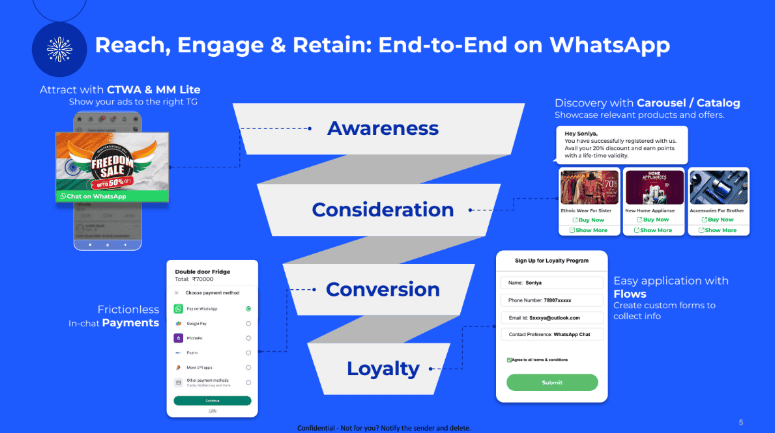
Awareness: Reach high-intent customers
At the awareness stage, the goal is to attract potential customers and start conversations.
Businesses can leverage:
- Click-to-WhatsApp Ads (CTWA)
- Marketing messages
- QR codes
- Website WhatsApp chat widgets
- Social media WhatsApp entry points
For example, a retail brand runs Click-to-WhatsApp Ads during a seasonal campaign, allowing interested customers to start a conversation directly from the ad instead of filling out a form.
Consideration: Help customers explore and evaluate
Once customers express interest, WhatsApp can help them discover products and find the information they need to make a decision.
Businesses can leverage:
- Product catalogs
- Carousel messages
- Rich media messages
- Product recommendations
- Interactive buttons
For example, an ecommerce brand shares a product carousel featuring recommended products based on customer preferences, enabling users to browse options without leaving WhatsApp.
Conversion: Reduce friction and drive action
At the conversion stage, the objective is to simplify the path to purchase and help customers complete their intended action.
Businesses can leverage:
- WhatsApp flows
- Lead capture forms
- Appointment booking workflows
- Abandoned cart reminders
- In-chat payments
- Personalized offers
For example, a customer receives an abandoned cart reminder and completes checkout directly through an in-chat purchase journey, reducing drop-offs and improving conversion rates.
Loyalty: Build long-term customer relationships
After a purchase, WhatsApp helps businesses maintain engagement and encourage repeat interactions.
Businesses can leverage:
- Personalized follow-ups
- Order updates and notifications
- Loyalty program communications
- Customer support automation
- Feedback and survey campaigns
- Replenishment and reorder reminders
For example, a beauty brand sends personalized reorder reminders and loyalty rewards to existing customers, encouraging repeat purchases while maintaining ongoing engagement.
How to maximize ROI and scale your WhatsApp marketing campaigns?
There are KPIs, i.e., key performance indicators, that reflect certain metrics to track, monitor, and measure the performance of your campaign.
Messages sent or delivered, reply rate, read rate, CTR, and response time are major KPIs that indicate how well your WhatsApp marketing campaign is performing.
To begin with, it is also essential to understand that different campaigns in themselves have different objectives, and hence, the evaluation for performance changes accordingly.
Campaign objectives usually vary across awareness, conversion, and customer retention, which is why performance evaluation metrics also differ accordingly.
Scale with Marketing Messages Lite API
Reach the right audience with targeted, high-volume marketing campaigns. Improve campaign efficiency while optimizing marketing spend. Extend the reach of promotional messages without adding operational complexity.
Personalization with CRM Integration
Connect WhatsApp with your CRM to leverage customer preferences, purchase history, and engagement data.
Deliver more relevant campaigns that improve engagement and conversion rates. Create tailored customer journeys based on real-time behavior.
Enable Conversational Commerce
Allow customers to browse products, ask questions, and complete actions without leaving WhatsApp. Reduce friction throughout the buying journey. Support faster decision-making and lower abandonment rates.
Outcome-Driven Campaign Framework
Setup
Before launching campaigns, establish the foundational elements:
- Register and verify your WhatsApp Business Account.
- Set up your display name and business profile.
- Define message templates for marketing, utility, and support use cases.
- Integrate catalogs, automation workflows, and chatbot capabilities where required.
Go live
Launch campaigns with a controlled and measurable approach:
- Run pilot campaigns before scaling.
- Segment audiences based on engagement level, purchase history, and customer lifecycle stage.
- Enable conversational journeys for product discovery, purchases, support, and feedback collection.
Scale
Once campaigns are performing consistently, focus on optimization and expansion:
- Conduct A/B testing for messaging, creatives, and CTAs.
- Expand personalization efforts using CRM and customer data integrations.
- Trigger campaigns based on real-time customer actions and events.
- Acquire and engage customers through Click-to-WhatsApp Ads, QR codes, email campaigns, short links, and other channels.
- Continuously refine campaigns based on performance insights and customer engagement patterns.
What are some common mistakes in WhatsApp Marketing?
WhatsApp is a high-engagement, personalized messaging platform, but there are rules, compliance requirements, and unsaid user expectations businesses need to follow.
When brands tend to make these common mistakes, they witness their engagement dropping, higher opt-outs, and even further consequences.
Here are the mistakes you need to avoid:
- Don’t send marketing messages without customer opt-in.
- Don’t ignore opt-out requests or preference management.
- Don’t misuse customer data for personalization.
- Don’t use unclear messaging or weak CTAs.
- Don’t send irrelevant content that adds little value to customers.
- Don’t launch campaigns without tracking performance metrics.
FAQs
How do you create Ads using WhatsApp Business?
You can leverage this by creating ads on WhatsApp Business. Go to the advertised Getting Started.
From there, choose what you are planning to advertise and then include all the information, besides fixing the daily budget, audience, and duration. After reviewing, you are all set to launch your ad to promote the business.
Is WhatsApp Marketing beneficial for small businesses?
WhatsApp marketing is ideal for all business ranges, from small to large, as the platform is a potent tool for reaching and engaging customers. Their features make it perfect for communicating in real time, making it personal and more direct.
Can you send promotional content to anyone on WhatsApp?
WhatsApp has strict rules against promotional content and business guidelines. This is to prevent spam while protecting privacy. However, the business can only send promotional content to those who have consented.
What is WhatsApp marketing?
WhatsApp marketing is a strategic use of the WhatsApp application to send consent-based, personalized messages to users for product promotions, customer support, updates, and engagement.
What’s the difference between the WhatsApp Business app and the WhatsApp API?
The WhatsApp Business app is a free application designed for micro and small businesses to manage their business communications at a manual level, offering basic yet limited features. WhatsApp API, on the other hand, is specifically built for highly scalable communication, supporting a plethora of advanced features targeted towards medium to large businesses.
What are the benefits of WhatsApp marketing for businesses?
WhatsApp marketing allows businesses to send highly personalized messages to their customers, leveraging rich media and interactive features. It is a real-time two-way communication promising high open and engagement rates with improved customer experience and engagement.
What are WhatsApp marketing best practices in 2026?
The best practices for WhatsApp marketing are sending highly relevant, value-focused, concise messaging after clear user consent is obtained. Hyper-personalization, segmentation, and relevant, clear CTAs will give you the best results.
How do you optimize a WhatsApp Business profile in 2026?
To optimize your WhatsApp Business profile, make sure to finish all the essential details, set up the quick replies, create products with a catalog, and use message automation. Ensure you have consistent branding across messaging and also have trust signals like a verified profile to establish credibility.
Conclusion
WhatsApp Marketing for Businesses is a powerful, wide-reaching, direct communication platform.
From creating a meaningful connection to adding value to make the customer feel special, loyal, and well-connected, the platform indeed has tons of benefits for a business.
The platform actively increases DAUs by 4% and ensures more brand exposure. Besides being an effective solution, look for migration and use it to save yourself from hassle and time waste.
We at Route Mobile are a leading cloud-communication software provider, providing a one-stop solution with our WhatsApp business API solution, which includes embedded signup, an AI-powered chatbot, categories for product display, and more.
To get started with WhatsApp marketing for business, contact our experts today!