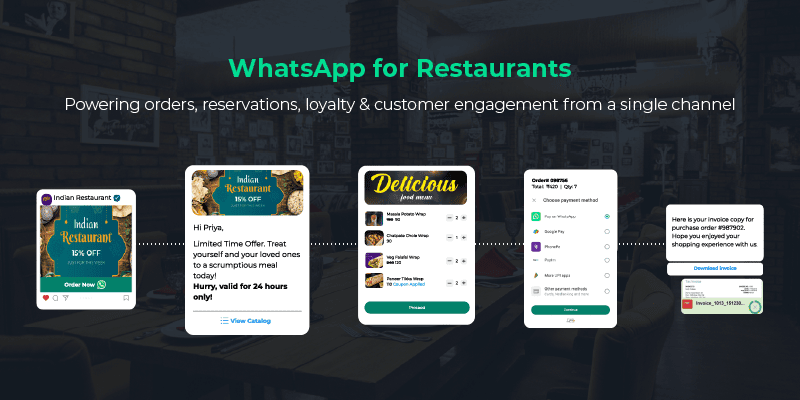
India’s food services market is currently valued at around $90 billion,[3.1] and it’s expected to grow to nearly $150 billion by 2030, with organized players (aggregators, cloud kitchens, digital-first brands) leading that growth at a 17-18% CAGR. Online food delivery specifically is set to grow its share of that market from 11% in FY26 to 18% by FY31, and food delivery transactions in tier 2 and smaller cities have nearly tripled since FY21.
Behind that growth sits a margin problem unique to F&B: aggregator commissions of 18 to 30% [4.1]per order eat directly into restaurant margins. That’s pushing restaurants, cloud kitchens, and QSR chains toward building a direct channel with customers, one that doesn’t run through a third-party platform for every transaction. WhatsApp for restaurants is where that channel is being built.
WhatsApp for restaurants
WhatsApp for restaurants means using the WhatsApp Business API to run the customer-facing side of a food business, ordering, reservations, marketing and support, on a single conversational channel instead of scattering it across apps, calls and third-party platforms.
Customers can browse a menu and check out inside a chat thread with the order routing straight into the restaurant’s POS system, book a table through a structured flow that follows up with automated reminders to cut no-shows, receive offers and loyalty nudges directly instead of paying an aggregator for the reach, and get order or delivery queries resolved in-chat, with a live agent stepping in only when needed.
Together, these use cases turn WhatsApp from a support channel into full-funnel infrastructure, exactly what a business needs to reduce aggregator dependency and own the customer relationship end to end.
Beyond India: the same pull, different starting point
This isn’t an India-only shift. In the GCC, WhatsApp is showing up in F&B as an enterprise customer experience layer, with QSR chains using it for order routing and precise delivery coordination at scale. In Southeast Asia, the entry point looks different again: brands are using click-to-WhatsApp (CTWA) ads to convert paid social traffic directly into WhatsApp conversations, treating WhatsApp as an acquisition channel rather than just a support one, with measurable lifts in lead quality compared to standard ad formats.
Three markets, three different reasons to adopt WhatsApp, but the same underlying shift: food ordering is moving off single-purpose apps and onto the conversational channel customers already use for everything else.
Food ordering market trends: personalization is now the price of entry
According to Tillster’s Phygital Index Report, 58% of diners say they’re more likely to recommend a QSR after a personalized ordering experience, while 33% have skipped ordering from a QSR altogether when that personalization was missing, a gap that’s nearly doubled since 2023, when it stood at 21%. Self-service preferences tell the same story: 61% of kiosk users now wish restaurants offered more self-service kiosks, up from 57% the year before and just 36% two years prior.
Diners aren’t just responding better to personalization when it’s offered; they’re actively walking away when it isn’t, and that walk-away rate is accelerating year over year.
The need of the hour
QSRs can no longer treat personalization as a differentiator reserved for their best customers or their loyalty program’s top tier. It’s becoming the baseline expectation at every ordering touchpoint, kiosk, app, or chat.
The brands closing this gap fastest are the ones building it directly into their ordering flow rather than bolting it on as a separate marketing layer, which is exactly where a channel like WhatsApp, already personal by nature, has an advantage over generic in-app promotions.
The complete customer lifecycle in F&B: powered by WhatsApp
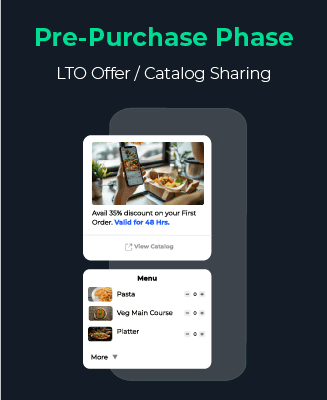
Food ordering on WhatsApp isn’t limited to placing and tracking an order; it spans the entire customer lifecycle, from the first discovery to the next visit. Before a purchase happens, WhatsApp supports outlet locators, limited-time offers, catalog sharing, promotions and coupons; the groundwork that gets a customer into a conversation in the first place.
Once a purchase is underway, the same thread handles order placement, gift card or voucher purchases, membership upgrades and upselling, and loyalty redemption, turning a single transaction into a fuller relationship.
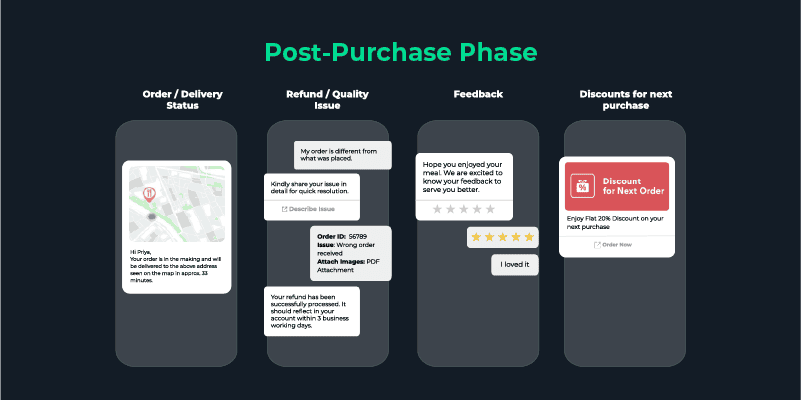
And post-purchase, WhatsApp carries the business through order and delivery status updates, refund or quality issue resolution, feedback collection, and discounts that bring the customer back for their next order. Seen this way, WhatsApp isn’t a channel bolted onto one stage of the journey; it’s a conversational commerce infrastructure that can support a customer from the moment they discover a restaurant to the moment they order again.
Why food ordering demands a full-funnel WhatsApp strategy
In most industries, WhatsApp’s value sits after the transaction: confirm it, track it, resolve issues if something goes wrong. Food ordering is different. WhatsApp has real work to do before the order exists too: discovery, menu browsing, table reservations, and the decision to reorder. That makes this a full-funnel channel, and it needs different templates and workflows depending on which end of the funnel you’re solving for.
Top of funnel: WhatsApp marketing for restaurants as discovery and acquisition
- Click-to-WhatsApp ads. A social ad opens straight into a WhatsApp thread with a prefilled message, “Hi, I’d like to see today’s menu,” skipping a landing page entirely with assisted Marketing Messages API. This is the mechanism behind measurable lead-quality lifts reported by F&B brands running CTWA in Southeast Asia.
- QR-code-triggered conversations. Table tents, packaging, and receipts turn a single transaction into an opted-in WhatsApp contact. Restaurants are placing these QR codes on table cards, delivery boxes, and takeaway receipts specifically to convert one-time orders into a direct channel.
- In-chat catalog browsing. For menus under roughly 40 items, customers can browse and order without ever leaving WhatsApp, collapsing discovery and conversion into a single thread instead of a multi-step app journey.
Major customer entry points
| CTWA | Leverage QR Codes |
| Vast Audience Pool | Website |
| Direct Engagement | Print Media |
| Higher Conversion Potential | Product packaging |
Bottom of funnel: WhatsApp Marketing for restaurant customer retention and repeat orders
- One-tap reorder. Regular customers get a “reorder your usual” prompt instead of rebrowsing a full menu. Restaurant deployments using this have reported repeat-order lifts in the 30 to 50% range.
- Reservation confirmation and reminder. A confirm-plus-reminder flow sent roughly two hours ahead of a booking has been shown to cut no-shows by 40 to 55% in reported restaurant use cases, directly protecting revenue that would otherwise sit as an empty table.
- Post-meal feedback capture. A short WhatsApp check-in after a meal routes a bad experience toward service recovery before it becomes a public review, and a good one toward a review ask.
- Loyalty and occasion-based messaging. Birthday offers, points balances, and re-engagement nudges run as marketing-category templates, closing the loop back to the top of the funnel by turning a past customer into a returning one.
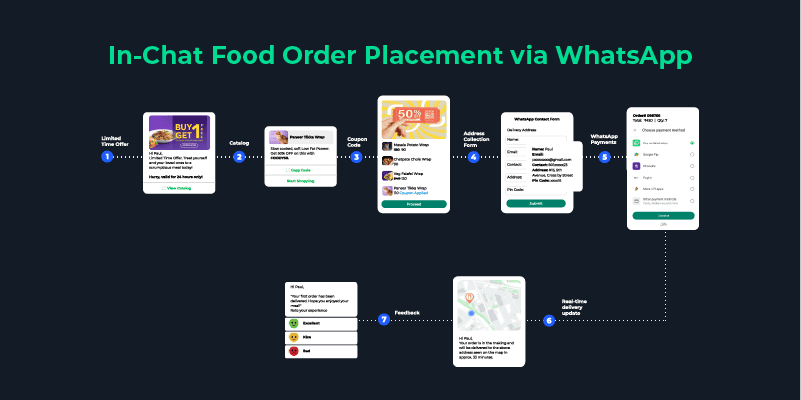
The full journey: from acquisition to repeat, on a single channel
Laid end to end, these pieces aren’t separate features; they’re one customer journey that never leaves WhatsApp.
A customer discovers a restaurant through a CTWA ad or scans a QR code on a table or delivery box. That first message triggers a flow, either an order, a reservation, or a menu browse, depending on what they came in for. The order itself gets placed through a structured flow rather than free-text back-and-forth.
If it’s a reservation, the same structured intake captures party size and occasion before a confirmation and reminder go out closer to the date. After the visit or delivery, a feedback check-in closes the loop, and a loyalty balance update keeps the relationship active.
Weeks later, an occasion-based nudge, a points reminder, or a “reorder your usual” prompt brings the same customer back in, restarting the cycle without a single new ad dollar spent.
Where templates do the work underneath
Each of these stages runs on a different WhatsApp template category, and knowing which one matters, because they behave differently on cost, opt-in requirements, and delivery windows.
- Marketing templates power the top of the funnel: CTWA-triggered messages, occasion-based offers, and loyalty nudges. These require explicit opt-in and carry marketing-tier pricing, but they’re the only category that can proactively re-engage a customer who hasn’t messaged recently.
- Utility templates carry the operational middle: order confirmations, reservation confirmations, reminders, and status updates. These ride on the back of an existing transaction, so they don’t require the same opt-in friction as marketing sends, and they’re what makes the ordering and booking experience feel instant rather than manual.
- Authentication templates show up narrowly but matter at points where identity or payment verification is involved, high-value order confirmation, or account-linked loyalty redemption.
- Flows aren’t a template category on their own, but the structured-form layer that sits inside utility and marketing messages, turning what would be a multi-turn conversation (ordering, booking, feedback) into a single guided interaction.
WhatsApp Chatbot for restaurants: automating the full conversation
A WhatsApp chatbot for restaurants handles the volume of routine, repetitive requests that would otherwise tie up staff time, resolving what it can instantly and escalating the rest to a live agent with full context attached.
Most of this runs on no-code, rule-based flows, sufficient for FAQs, order status, and basic routing. Personalized recommendations, however, need an AI layer on top: a rule-based bot can prompt “reorder your usual,” but only an AI-integrated bot can infer and suggest based on order history and preference, the difference between automation and personalization at scale. Core use cases include:
- Ordering — guiding customers through menu selection, customization, and checkout without manual intervention
- Reservations — capturing party size, time, and occasion, then confirming the booking automatically
- FAQs — answering routine questions like “is this dish vegan” or “what time do you close” instantly, without human input
- Personalized recommendations — AI-driven suggestions based on past orders or preferences, turning a routine reorder into an upsell opportunity
For F&B or restaurant businesses specifically, a chatbot isn’t just a support layer; it’s the automation engine that makes ordering, booking, and retention run without adding headcount at every outlet, with the AI layer worth the investment once volume or personalization ambitions justify it.
Identifying use cases for businesses to employ ordering in chat
Let’s thoroughly explore the template categories covered above to identify the use cases supported by WhatsApp Business API.
Automating the order itself
Once a customer is in a WhatsApp thread, whether they arrived via a CTWA ad or a QR code, the order flow itself needs to run without manual intervention on the restaurant’s side.
This is where WhatsApp Flows do the heavy lifting: a structured, form-like interface inside the chat lets customers select items, choose quantities and customizations, and confirm an address, without a staff member manually noting down a phone order or a customer typing out a full order in free text.
The order data lands directly in the restaurant’s order management system, so kitchens aren’t juggling a separate workflow for direct orders. For cloud kitchens running multiple virtual brands out of one facility, this matters even more: each brand gets its own WhatsApp ordering flow, but all of it routes into a single kitchen queue.
Table reservations as a structured booking flow
Reservations need to capture more than a yes or no. A WhatsApp Flow can collect party size, preferred time, occasion, and special requests upfront, the same information a host would ask over the phone, but without tying up a staff member’s time.
For restaurants running multiple outlets, this flow can route the booking to the correct location’s reservation system automatically based on which outlet’s number or QR code the customer used. This is distinct from the reminder-and-confirm messaging already covered; this is the actual intake step that happens before a booking exists at all.
Menu sharing that adapts to the moment
A menu shared over WhatsApp doesn’t have to be static. Businesses can push different menu templates depending on context: a lunch menu during midday hours, a dinner or event menu in the evening, or a limited-time offer menu tied to a specific promotion.
Enabling in-chat catalog browsing while controlling what version of the menu a customer sees and when proves to be useful for restaurants juggling breakfast, lunch, and dinner offerings, or seasonal specials, without needing to rebuild their ordering catalog every time.
Loyalty programs with real account-level tracking
Beyond one-off birthday or occasion messages, a structured loyalty program on WhatsApp can track a customer’s points balance, tier status, and redemption history directly inside the chat thread, no separate app download required.
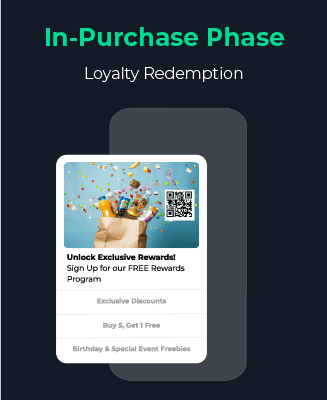
A customer can check “how many points do I have” and get an instant, accurate answer, or redeem a reward directly within the ordering flow at checkout. This turns loyalty from a marketing broadcast into a persistent, quarriable relationship, which matters for restaurants trying to compete with the loyalty programs built into some well-known platforms today, where the aggregator, not the restaurant, currently owns that relationship.
Customer support that handles the full range of queries
Not every WhatsApp message from a customer is an order or a booking. Order modification requests, allergy or ingredient questions, delivery delay queries, and billing disputes all need a support layer that can handle routine questions automatically and escalate the rest.
A chatbot can resolve common queries instantly, “is this dish vegan,” “can I add extra cheese,” “what time do you close”, while flagging anything that needs a human, a wrong charge, a missing item, or a complaint to a live agent with the full conversation context already attached, so the customer doesn’t have to repeat themselves.
Metrics worth tracking for most desired outcome
The metrics that matter shift depending on which end of the funnel a business is optimizing:
- Top of funnel: CTWA click-to-conversation rate, QR scan-to-first-order rate, cost per acquired WhatsApp contact compared to aggregator customer acquisition cost.
- Ordering and reservations: Flow completion rate (how many customers who start an order or booking actually finish it), average order value on direct WhatsApp orders versus aggregator orders, no-show rate against the reservation reminder.
- Retention: repeat-order rate and time-to-reorder for customers acquired via WhatsApp, loyalty redemption rate, and the share of total order volume coming from the direct WhatsApp channel versus aggregators, since that ratio is the clearest signal of whether the direct-channel strategy is actually working.
How Route Mobile is already delivering this for F&B brands
The impact isn’t theoretical, it shows up in real deployments across QSR chains already running WhatsApp through Route Mobile.
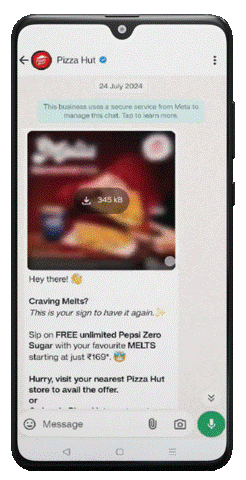
Sapphire Foods (Pizza Hut) increased footfalls with WhatsApp
Coupon-led WhatsApp campaigns drove real store visits, not just clicks. Walk-ins for code redemption increased by 25%, conversion rates doubled from 2% to 4%, and the brand has sent 500k coupons across 140 stores, with plans to scale to 750+ stores.
“Route Mobile integrated WhatsApp Business API with our CRM and applications seamlessly. Their team demonstrated excellent technical expertise and completed the setup in under two weeks. This enabled us to launch quickly at record speed while scaling cost-effectively.”
— Umesh S., Head of IT & Products, Sapphire Foods
Americana Restaurants: WhatsApp-powered delivery for KFC and Pizza Hut
Americana Restaurants, the largest operator in MENA and Kazakhstan, runs KFC, Pizza Hut, Hardee’s, and Krispy Kreme across 12 countries and 2,600+ outlets. By leveraging WhatsApp for real-time order routing, masked phone numbers between customers and drivers, and high-precision geolocation pin sharing, the brand saw a 30% increase in orders across KFC and Pizza Hut, delivery times cut by half, and stronger customer trust through secure, direct communication.
What these results have in common
A dine-in chain scaling coupon redemption and a multi-brand delivery operation spanning 12 countries look like very different businesses, but both point to the same underlying shift: when ordering, offers, and delivery run through a single, secure WhatsApp thread instead of fragmented channels, both walk-ins and conversions move in the same direction, up.
Getting started: onboarding on WhatsApp Business API with Route Mobile
Getting a food business onto WhatsApp isn’t just a matter of registering a number; it runs through Meta’s Cloud API, the infrastructure layer that actually sends and receives messages at scale, and a Business Solution Provider (BSP) like Route Mobile, which sits between the brand and that infrastructure to handle everything Meta doesn’t provide directly.
This distinction matters because high-volume F&B operations, chains running thousands of orders a day across multiple outlets, can’t run reliably on a self-managed API connection alone. They need template approval management, uptime and delivery guarantees, multi-agent access, CRM and POS integrations, and support when something breaks at 8 pm on a Friday, exactly the layer a BSP exists to provide.
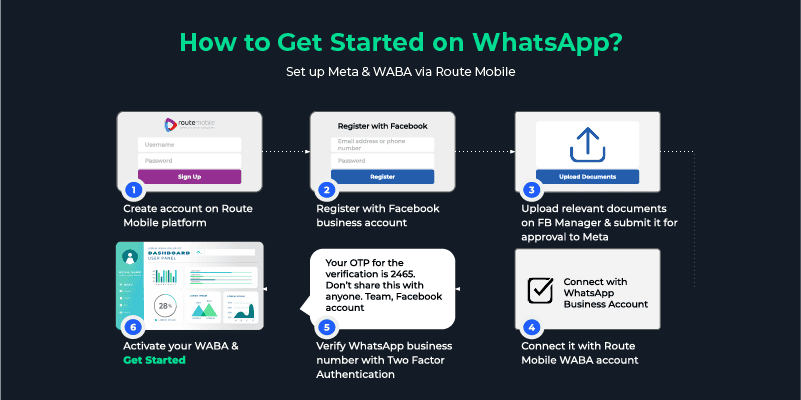
The onboarding itself starts simply: create an account on the Route Mobile platform and register a Facebook Business account, the entry point into Meta’s WhatsApp ecosystem. From there, Route Mobile manages the technical weight on the brand’s behalf, submitting documents for Meta’s approval, connecting the number to a verified WABA, and activating the account, so a restaurant chain or cloud kitchen doesn’t need an in-house engineering team to go live. The remaining steps follow as shown in the image below
FAQs
What is WhatsApp Business API (WABA)?
WhatsApp Business API is Meta’s platform for medium and large businesses to communicate with customers at scale, enabling automated messaging, catalogs, and integrations that go beyond what the free WhatsApp Business app supports.
How is WhatsApp Business API different from the regular WhatsApp Business app?
The app suits small, single-user businesses handling manual conversations. The API is built for scale, automation, integration with POS/CRM systems, and multi-agent access, essential for restaurant chains, cloud kitchens, and multi-outlet operators.
Can customers actually place food orders directly on WhatsApp?
Yes. Using WhatsApp Flows, customers can browse a menu, select items, customize an order, and confirm delivery details entirely within the chat, with the order routing directly into the restaurant’s existing POS or order management system. This requires WhatsApp Business API integration from a Meta-approved Business Service Provider (BSP)
Do I need a BSP like Route Mobile, or can I connect to Meta’s Cloud API directly?
Technically, a business can connect directly, but high-volume F&B operations need the layer a BSP provides: template approval support, uptime guarantees, CRM/POS integrations, multi-agent access, and technical support- infrastructure most restaurant chains don’t want to build and maintain in-house.
What’s the difference between utility, marketing, and authentication templates?
Utility templates cover transactional messages like order confirmations and reservation reminders. Marketing templates handle promotions, offers, and re-engagement, and require explicit opt-in. Authentication templates verify identity, such as OTPs for high-value orders or loyalty redemption.
How does WhatsApp help reduce dependency on aggregators like Zomato or Swiggy?
By enabling direct ordering, loyalty tracking, and repeat-order flows on a channel the business owns, WhatsApp gives restaurants a way to build a direct customer relationship instead of routing every order (and its commission) through a third-party platform.
Does WhatsApp ordering work for reservations too, not just delivery?
Yes. A structured Flow can capture party size, time, and occasion for table bookings, then follow up with automated confirmations and reminders, reducing no-shows without manual staff involvement.
How long does it take to get set up on WhatsApp Business API?
Implementation timelines vary by integration complexity, but Route Mobile deployments for F&B brands have gone live in as little as two weeks, including full CRM and system integration.
Is WhatsApp ordering only relevant for large chains, or can smaller restaurants use it too?
Both. Cloud kitchens and single-location restaurants can start with QR-code-triggered ordering and basic automation, while multi-outlet chains scale into full CRM integration, loyalty tracking, and multi-location routing.
Does this work outside India?
Yes, the underlying capability is the same globally, though adoption drivers differ by region: commission pressure in India, enterprise CX investment in the GCC, and paid-acquisition-led adoption in Southeast Asia.
What is a WhatsApp chatbot for restaurants?
WhatsApp chatbot automates routine customer interactions, ordering, reservations, FAQs, and order status, directly inside a chat thread. Most run on no-code, rule-based flows for standard queries, while an AI-integrated layer adds personalized recommendations based on order history, escalating only complex requests to a live agent.
How can restaurants use WhatsApp for marketing?
Restaurants can leverage WhatsApp marketing to send offers, loyalty nudges, and occasion-based messages directly to opted-in customers, through click-to-WhatsApp ads that turn social traffic into conversations, QR codes that convert one-time diners into a direct channel, and marketing-category templates like birthday offers and re-engagement prompts that bring past customers back without paying an aggregator for the reach.
Conclusion
Whether it’s an Indian cloud kitchen sidestepping commission fees, a GCC QSR chain coordinating delivery at scale, or a Southeast Asian brand acquiring customers through paid social, the pattern is consistent.
WhatsApp is no longer just where restaurants talk to customers after an order lands. It’s where the order starts, where loyalty gets built, and where the next visit gets decided, all inside a single, opted-in conversation the customer already trusts.
The brands proving this out- Sapphire Foods, Americana Restaurants, and others- didn’t get there by treating WhatsApp as one more notification channel. They built it into the full customer lifecycle, backed by the infrastructure to run it reliably at scale.
Ready to bring this to your own F&B business? Route Mobile’s WhatsApp Business Platform can be tailored to your order volume, region, and customer base. Get in touch with our team to explore what this looks like for you.