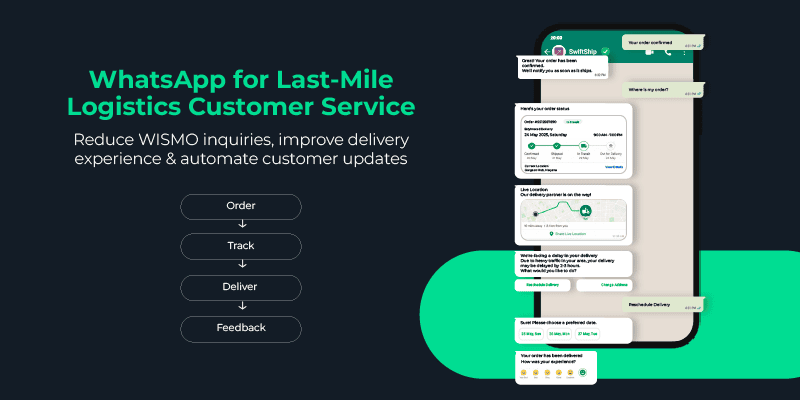
Last-mile delivery is where India’s e-commerce, food delivery, and grocery sectors either win a customer for life or lose one for good. Globally, the last mile now eats up 53% of total shipping costs, up from 41% in 2018. India’s own numbers show why that pressure is just as real here: the country’s last-mile delivery market is valued at roughly $7.4 billion, growing at a 13–14% CAGR as online shopping pushes deeper into tier 2 and tier 3 cities.
The cost of getting it wrong is steep. India’s average return-to-origin (RTO) rate sits at approximately 23%, and COD orders carry a return rate far higher than prepaid ones, climbing to 40–49% in tier 2 and tier 3 cities, where COD makes up 58–64% of all orders. Every failed delivery means paying for forward shipping, reverse logistics, and a lost sale, all at once.
Quick commerce has raised the bar further, normalizing 10 to 30-minute delivery windows and training customers to expect real-time visibility on every order, not just the fast ones.
This is the gap WhatsApp is closing. Measured read rates for opted-in WhatsApp broadcasts in India run 70–90%, well above email and SMS, making it the clearest channel available for closing the last-mile trust gap.
Three gaps WhatsApp closes:
-
Businesses without WhatsApp triggers miss out on recovering abandoned carts and applications — automation can recover 45–70% of these
-
Without WhatsApp, businesses lose the ability to engage customers through real-time conversation
-
Personalization, live tracking, and support have become essential to a strong delivery experience
Beyond India: WhatsApp and last-mile logistics in the GCC
Move past India, and the story doesn’t repeat, it changes shape. The GCC last-mile delivery market was valued at $16.2 billion in 2025 and is projected to grow at 8.6% CAGR through 2032 to reach $28.8 billion, with e-commerce accounting for 70% of that market and Saudi Arabia alone commanding 45% of it.
But the failure point here isn’t address chaos or COD refusal rates, it’s expectation mismatch. WhatsApp penetration exceeds 80% of the adult population across the UAE, Saudi Arabia, and Qatar, and 55% of large UAE organizations already name WhatsApp Business as their top digital investment priority over the next five years.
In a market this WhatsApp-saturated, a business without conversational commerce isn’t losing to failed deliveries, it’s losing to competitors who made ordering, tracking, and support feel native to how customers already communicate.
Where last-mile delivery actually breaks down
The failure points differ by market, but they trace back to the same root cause: a communication gap between order placement and delivery.
In India, most failures are preventable at the source. Impulse COD orders get placed and forgotten, and without a quick check-in, a large share become RTOs. Addresses in tier 2 and tier 3 cities are often landmark-based rather than geocoded, so shipments misroute before they even leave the warehouse.
Customers aren’t notified of delivery windows, so no one’s home when the rider arrives. And silence after the order is placed pushes customers to assume the worst, either cancelling outright or flooding support with “where is my order” queries.
In the GCC, the failure point looks different because the infrastructure problem is largely solved. Addressing systems are more reliable, COD is less dominant, and WhatsApp penetration already exceeds 80% of the adult population across the UAE, Saudi Arabia, and Qatar.
Adopting conversational commerce and logistics alerts via WhatsApp aligns with both global trends and consumer behavior in the GCC.
-
85% of UAE and KSA e-commerce customers prefer delivery partners who provide real-time order status
-
68% of customers in the GCC engage better with bilingual communication
globalmediainsight
The gap is one of expectation, not logistics. Customers who are used to instant, bilingual, conversational service across other channels expect the same from delivery updates. A generic notification or customer support that isn’t available in the customer’s preferred language can feel like poor service, even when the package arrives on time.
The solution is the same across different markets. Whether the issue is an incorrect delivery address or updates that aren’t provided in a language customers naturally use, the underlying problem is communication rather than logistics. That’s exactly where WhatsApp fits, enabling real-time, conversational, and multilingual interactions that help resolve issues quickly and improve the overall delivery experience.
Why WhatsApp works: a channel built for both sides of the transaction
Every use case that follows solves two problems at once, one for the business, one for the customer, because that’s structurally how WhatsApp works. A business gets lower support costs, higher delivery success, and a channel customers already trust. A customer gets instant answers, less anxiety, and control over their own delivery. Neither side is trading something away for the other, which is why WhatsApp adoption keeps compounding in both India and the GCC rather than plateauing.
Here’s what that looks like in practice, mapped to the WhatsApp Business API’s template categories: utility, marketing, and authentication.
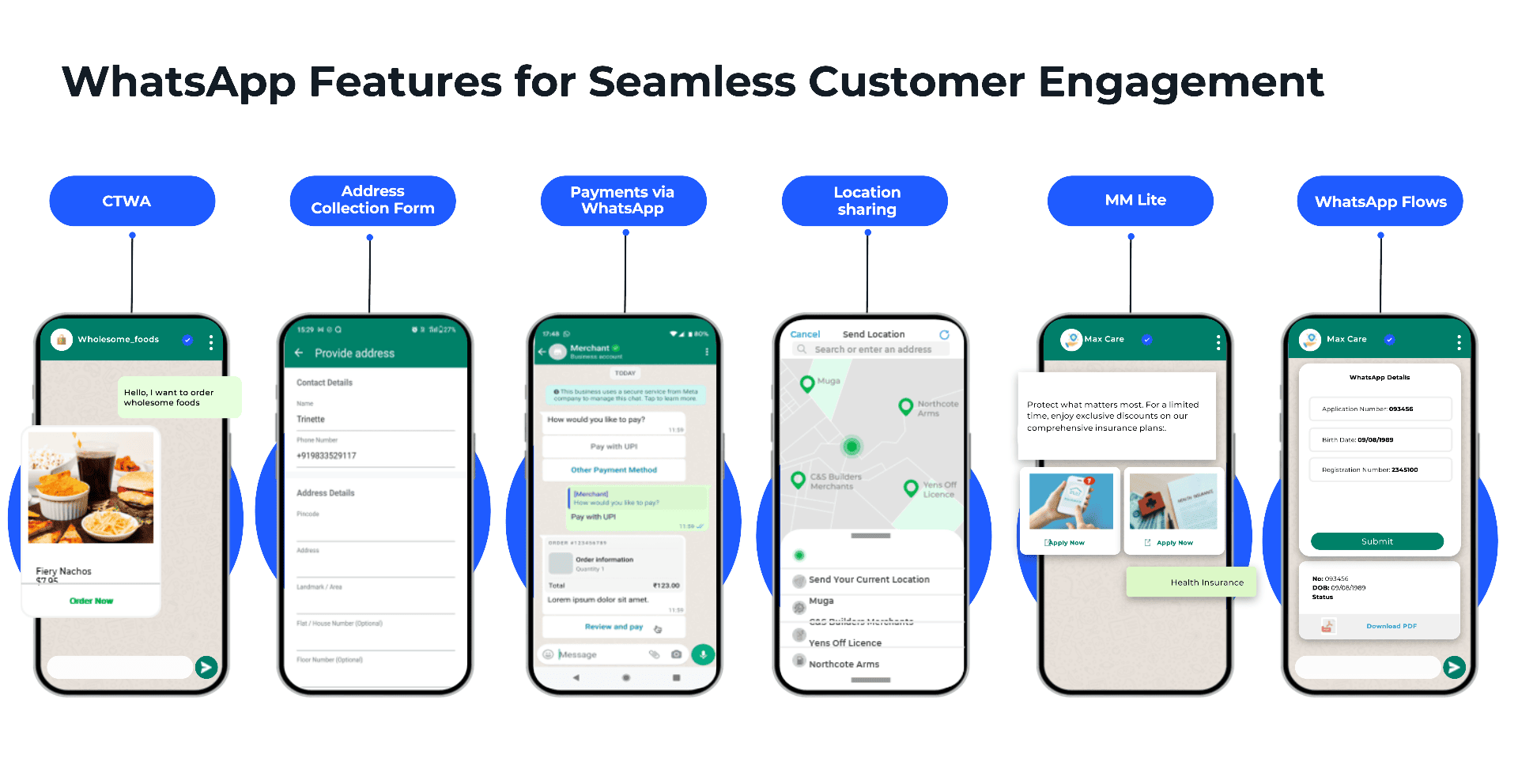
Utility templates: the workhorse of logistics communication
Utility templates cover transactional, expected communication, order confirmations, shipping updates, delivery reminders, and they’re the backbone of any logistics WhatsApp deployment because customers who’ve placed an order have implicitly opted in to hear about it.
Example: order and shipment status. A customer orders a mobile accessory COD. The moment the order is placed, a utility template confirms the order with a one-tap confirm or cancel button. The business filters out impulse orders before dispatch, while the customer gets a clear record and an easy way to cancel if it was a mistake.
Example: failed delivery, instant reschedule. If a rider can’t complete delivery, a utility template fires immediately with reschedule options built into WhatsApp Flows, no call, no ticket. The business avoids a second blind attempt (expensive in both regions, differently: in India it’s a fuel-and-time cost, in the GCC it’s an SLA and enterprise reputation cost). The customer reschedules in two taps instead of missing a call and waiting for someone to try again.
Marketing templates: recovery and re-engagement, done right
Marketing templates need explicit opt-in and carry Meta’s marketing-category pricing, but they’re the direct lever behind cart and application recovery.
Example: abandoned cart or application recovery. A customer adds items to a cart or starts a loan/insurance application and drops off. A marketing template nudges them within a defined window, sometimes with a small incentive attached. This is the mechanism behind the 45–70% recovery rate for automation-triggered nudges. The business recovers revenue it would otherwise write off entirely. The customer gets a helpful reminder rather than losing something they’d already decided they wanted.
Example: dialect-targeted broadcast. A GCC retailer segments a marketing broadcast by Khaleeji versus Hijazi Arabic instead of sending one generic Arabic message. Click rates lift 15–30% in this kind of segmentation. The business gets meaningfully higher conversion from the same send volume. The customer gets a message that actually reads like it was written for them, not machine-translated at them.
Authentication templates: trust at the moments that matter
Authentication templates are narrow by design, OTPs and identity verification, but they matter disproportionately in logistics and B2B contexts where account access, payment confirmation, or high-value order verification is involved.
Example: COD reconfirmation at the door. In high-RTO Indian markets, an authentication-adjacent utility template confirms the order one more time just before the rider arrives, filtering out last-minute refusals. The business avoids a wasted delivery attempt. The customer avoids being pressured into accepting something they no longer want.
How conversational AI is transforming logistics customer service
Conversational AI replaces the reactive ticketing model with proactive, automated, two-way communication, which is delivered at scale, without human intervention for routine queries.
AI chatbots make the whole process simple for both the buyer and the seller. It sends out direct updates about the order without even the customer asking for it. Instead of an agent manually rescheduling a failed delivery, a chatbot handles the entire flow, confirming a new slot, updating the logistics platform, and notifying the driver in minutes.
For a logistics company managing thousands of shipments daily, this process is simply transformative and quicker. It handles repetitive queries, reducing dependency on human agents and thus dividing the workload. A WhatsApp chatbot for logistics can handle WISMO inquiries at scale with zero agent load, instant response pulled directly from your tracking system, 24/7.
WISMO (“where is my order”) queries are usually the single largest category of inbound customer service volume for any business shipping physical goods, because once an order is placed, the biggest source of customer anxiety is simply not knowing where it is, and without proactive updates, it’s usually the single biggest driver of support ticket volume. It typically shows up as:
-
“Where is my order?”
-
“When will my package arrive?”
-
“Has my order shipped yet?”
This shift is not just about efficiency, but it’s about creating a seamless, always-on customer experience.
WhatsApp chatbot workflow for logistics
The core workflow holds across both markets: order confirmation, live tracking, delivery-day alerts, reschedule handling, post-delivery feedback — but what sits inside each step shifts by region.
Order confirmation
In India, this is a filtering mechanism: a one-tap confirm or cancel button on COD orders screens out impulse purchases before they reach a delivery rider, directly targeting the 40–49% RTO rate seen in tier 2 and tier 3 COD orders.
In the GCC, order confirmation carries less RTO risk and more of a service-quality signal. With 55% of large UAE organizations already naming WhatsApp Business their top digital investment priority, a confirmation message is the first proof point of that investment, and it needs to land in the customer’s preferred dialect, not a generic Arabic or English template.
Address verification
Critical in India’s tier 2 and tier 3 markets, where landmark-based addressing drives a meaningful share of RTOs. Largely a non-issue in the GCC given more mature address infrastructure, so this step can often be skipped or simplified.
Live tracking and delivery-day alerts
This is where both markets align most closely. India’s quick commerce sector has normalized 10 to 30 minute delivery windows, and GCC customers, sitting inside one of the most WhatsApp-saturated regions in the world, expect the same real-time visibility as a baseline, not a differentiator.
COD reconfirmation at the door
High-value in India given COD’s 58–64% share of tier 2 and tier 3 orders. Lower priority in the GCC, where COD carries less weight in the payment mix and prepaid, card, and digital wallet options dominate.
Delivery exception alerts and rescheduling via WhatsApp Flows
When a delivery fails — wrong address, customer unavailable, access issue — WhatsApp Flows allow the customer to instantly reschedule, redirect, or flag the issue. No call required. No ticket raised. The loop closes automatically.
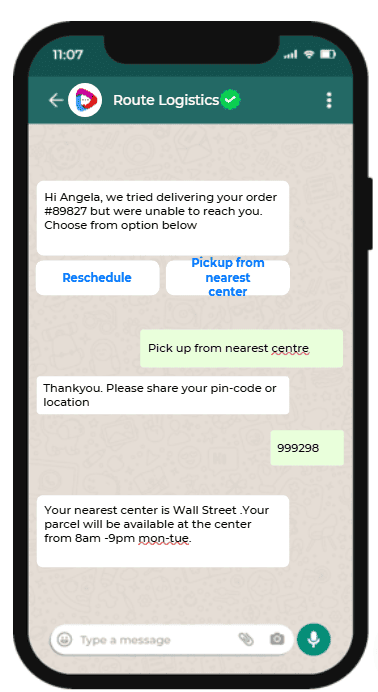
Brand or fulfillment error
Most wrong-item errors start upstream, at the brand or fulfillment level: a wrong SKU picked at the warehouse, an incorrect product listing, or a mismatch on a multi-item order. This is exactly where WhatsApp support earns its place.
A quick automated check-in can ask the customer what went wrong and request a photo, diagnosing the issue in seconds instead of a long back-and-forth. From there, the query routes automatically: wrong-item complaints to the fulfillment team, damaged-in-transit complaints to the logistics partner, so customers stop bouncing between the two.
Returns, replacements, and refunds can all be resolved in the same conversation. And because every complaint carries an issue type, a photo, and a timestamp, brands finally get a clear answer to whether their complaint volume is a fulfillment problem or a courier problem.
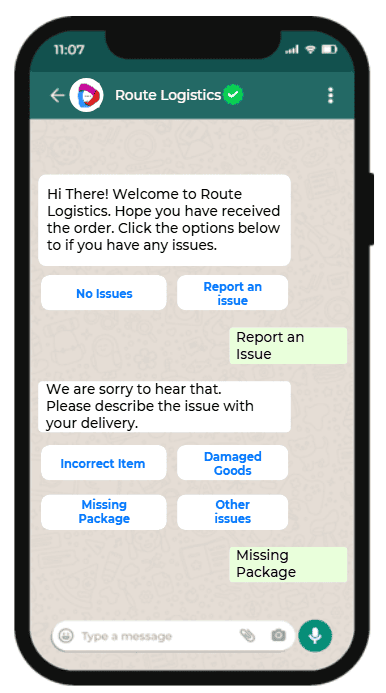
Post-delivery feedback
Functions the same way in both markets structurally, but in the GCC it doubles as a data point for the broader shift toward WhatsApp as core commerce infrastructure, not just a support channel, given the scale of enterprise investment already committed to the platform.
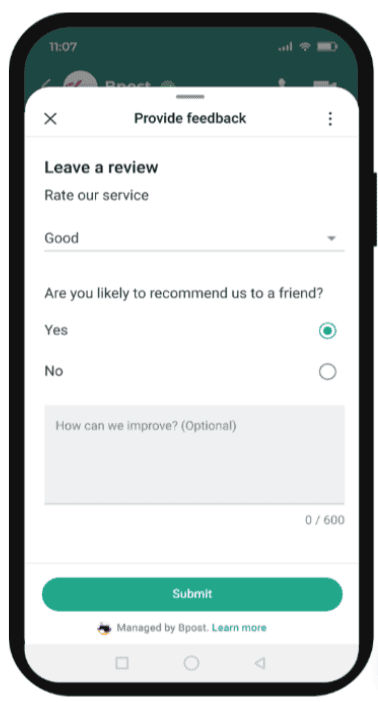
Modern logistics customer service should adopt these strategies based on customers’ problems.
-
Proactive — customers get updates without asking
-
Real-time — instant visibility into shipments
-
Conversational — on channels customers use
-
Mobile-first — aligned with user behavior
The post-purchase dissonance raises a lot of queries from the customer, which makes the customer fully involved in the process of delivery, like live updates, its exact location, how much more time, and so on. All these factors are exactly where WhatsApp excels.
For many brands, the customer’s journey ends at checkout, but in reality it creates a gap or a window between the order confirmation and delivery. This gap is exactly where the brand loyalty is either won or lost.
80% of buyers want consistent delivery status updates, and 60% of buyers expect brands to communicate during shipment delays. Poor communication during this phase is one of the biggest drivers of customer dissatisfaction even when delivery is successful.
How WhatsApp closes the loop: Route Mobile’s solution
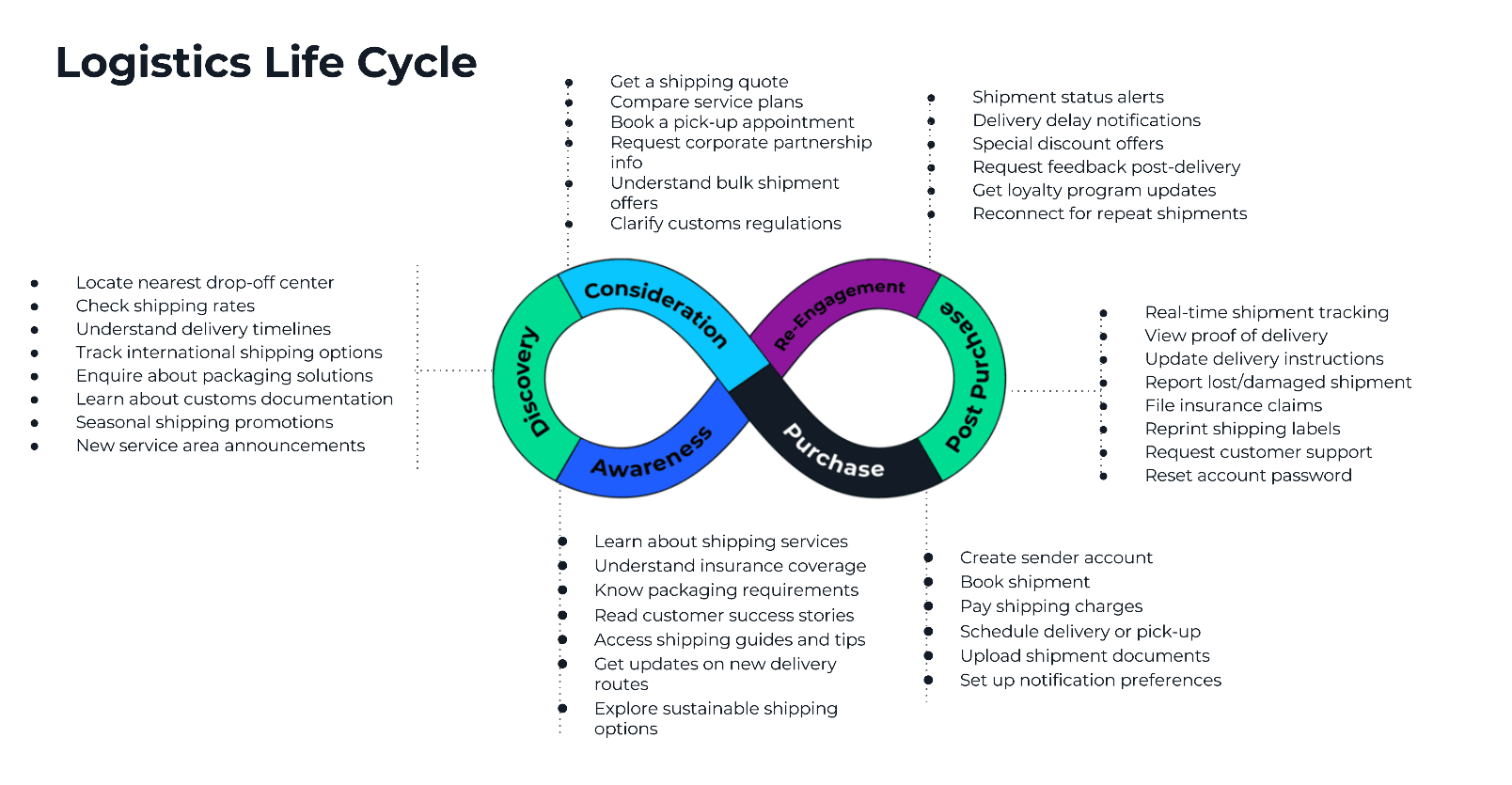
Route Mobile’s WhatsApp Business Platform gives logistics companies a complete, automated post-purchase communication system, and the results speak for themselves across three very different operators.
Automated proactive shipment updates
Customers get real-time updates at every milestone: order confirmed, dispatched, out for delivery, delivered, without a single manual intervention. The moment status changes in the logistics platform, the customer knows.
-
Americana Restaurants KFC, Pizza Hut, Hardee’s, Krispy Kreme, 2,600+ outlets across 12 countries) used WhatsApp for real-time order routing, masked driver-customer numbers, and high-precision geolocation sharing, resulting in a 30% increase in orders and delivery times cut by half.
WhatsApp chatbot for order queries
A chatbot handles WISMO inquiries at scale with zero agent load; customers type “where’s my order” and get an instant, accurate answer pulled straight from the tracking system, 24/7.
-
SPL (formerly Saudi Post), KSA’s government-run logistics and postal service, saw 50% reduction in call center wait times, 30% faster customer service response times, and 90% of customer inquiries resolved on WhatsApp alone, while managing 40 million shipments across the region.
Delivery exception alerts and rescheduling
When a delivery fails- wrong address, customer unavailable, access issue- WhatsApp Flows let the customer reschedule, redirect, or flag the problem instantly. No call. No ticket. The loop closes automatically.
-
Shiprocket Engage, India’s largest eCommerce enablement platform, used automated WhatsApp workflows to verify orders and delivery addresses upfront, cutting RTO losses by 45% and lifting contact rates 50% higher than traditional channels.
None of these outcomes run on WhatsApp alone, they run on the infrastructure behind it. As a Meta Business Solution Provider, Route Mobile handles the layer brands don’t see but depend on entirely: API integration with existing logistics and order management systems, template approval and category management (utility, marketing, authentication) to keep messaging compliant at scale, multi-language and dialect routing, masked number and data security protocols, and real-time delivery and read-rate reporting that feeds back into operational decisions.
For a brand, this means going live without building WhatsApp infrastructure from scratch, and scaling from thousands to millions of conversations without the compliance or reliability risk. Route Mobile has enabled this shift across e-commerce, QSR, government logistics, and enterprise supply chains, which is exactly why the results above span such different operators: the backend does the heavy lifting so the business only has to decide what the customer should hear, and when.
Practical steps to reduce WISMO volume
Reducing WISMO inquiries isn’t a one-fix; it’s about closing the communication gap at five points between order and delivery.
1. Send proactive order status updates
Don’t wait for the customer to ask. Automated milestone messages- order confirmed, dispatched, out for delivery, delivered- remove the need for a WISMO query in the first place. This is the highest-leverage step available where the update reaches the customer before the anxiety does.
2. Give customers real-time tracking
A generic tracking link isn’t enough. 80% of buyers want consistent delivery status updates, and 60% expect brands to communicate during delays. Live, chat-based tracking answers the “where is it” and “when will it arrive” questions before support ever gets involved.
3. Filter impulse COD orders at confirmation
A one-tap confirm or cancel button right after checkout screens out impulse purchases before they reach a rider, directly targeting the 40–49% RTO rate in tier 2 and tier 3 COD orders. Fewer bad orders in the pipeline means fewer downstream “where is my order” queries from customers who no longer want it.
4. Deflect WISMO queries with a chatbot
A WhatsApp chatbot answers “where’s my order” instantly, pulled straight from the tracking system, with zero agent load, 24/7. This is the mechanism behind SPL’s 90% of inquiries resolved on WhatsApp alone and a 50% reduction in call center wait times.
5. Resolve delivery exceptions through WhatsApp Flows
When a delivery fails- wrong address, customer unavailable, access issue- Flows let the customer reschedule or redirect in two taps. No call, no ticket. This is the step used by popular logistics companies to cut RTO losses and lift contact rates.
Together, these five steps shift WISMO handling from reactive (customer asks, agent answers) to proactive (customer never needs to ask). That’s the same shift behind Americana’s 30% increase in orders and delivery times cut by half.
End notes
Whether it’s a QSR chain in the GCC, a government postal service in Saudi Arabia, or an SME logistics platform in India, the same shift shows up: fewer calls, faster resolutions, and delivery problems caught before they become RTOs or lost customers. That’s not a regional trend. That’s what happens when logistics communication moves to the channel customers already use every day.
Ready to see what this looks like for your own delivery operations? Route Mobile’s WhatsApp Business Platform can be tailored to your specific order flow, region, and customer base. Get in touch with our team to explore the right use case for your business.