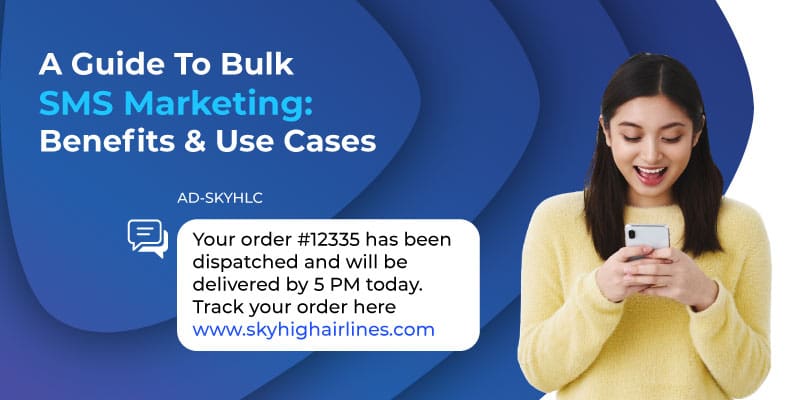
Bulk SMS marketing, also referred to as mass SMS marketing, is the process of sending text messages to a large group of recipients simultaneously for marketing, promotional, or customer engagement purposes. It enables businesses to reach customers instantly with offers, updates, reminders, event invitations, and other time-sensitive communications, making it one of the most effective channels for direct customer outreach.
The SMS marketing industry is projected to reach approximately $38.4 billion by 2030, growing at a CAGR of 21.26%. As businesses continue to prioritize personalized, mobile-first communication, bulk SMS marketing has emerged as a reliable and cost-effective way to engage customers, drive conversions, and strengthen brand relationships.
Suggested Read: 20 Fascinating SMS marketing statistics and trends
If you’re considering adding SMS to your marketing mix, this guide will help you understand the value of bulk SMS marketing and how it can support your business goals. We’ll explore how bulk SMS works, its key benefits, common use cases, best practices, and why it continues to be a preferred communication channel for businesses across industries.
What Is bulk SMS marketing?
Bulk SMS marketing is the process of sending text messages to a large number of recipients simultaneously for promotional, marketing, or customer engagement purposes. Businesses use it to share offers, product launches, discounts, event invitations, reminders, and other time-sensitive communications with targeted audiences directly on their mobile phones.
Unlike many digital marketing channels that rely on internet access, SMS reaches customers through the native messaging application on their devices, making it highly accessible and effective. This direct communication channel enables businesses to connect with customers quickly, efficiently, and at scale.
One of the biggest reasons businesses invest in bulk SMS marketing is its exceptional visibility. SMS messages achieve average open rates of up to 98%, with many recipients viewing messages within minutes of receipt. This immediacy makes SMS particularly valuable for campaigns that require instant customer attention, such as flash sales, appointment reminders, limited-time offers, and important updates.
Bulk SMS marketing also supports personalization through audience segmentation. Businesses can customize messages based on demographics, purchase history, location, customer preferences, and engagement behavior, helping improve customer experiences and campaign performance. As a result, organizations across industries continue to adopt SMS as a reliable, cost-effective, and scalable channel for driving engagement, conversions, and customer loyalty.
How does bulk SMS marketing work?
Bulk SMS marketing works by sending messages from a business application or platform through an SMS gateway, which then routes them to mobile network operators for delivery to recipients’ devices.
Simple 4-Step process:
- Step 1: Configure a sender ID or registered SMS route
Businesses first set up an approved sender identity, such as a Sender ID, short code, or DLT-registered template (where applicable). This helps ensure compliance with local regulations and improves message trustworthiness.
- Step 2: Create and send the campaign
Using a bulk SMS platform or SMS API, businesses upload recipient lists, create message content, personalize messages, and schedule or launch campaigns.
- Step 3: SMS gateway routes the messages
The SMS gateway securely processes the messages and forwards them through operator connections and carrier networks for delivery.
- Step 4: Messages reach recipients’ phones
Customers receive the SMS directly in their messaging inbox, where they can read, respond, click links, redeem offers, or take the desired action.
Flow:
Sender ID / DLT Registration → SMS Platform or API → Mobile Carrier Network → Recipient’s Mobile Phone
This streamlined process enables businesses to send thousands—or even millions—of messages simultaneously while maintaining speed, reliability, and scalability.
Bulk SMS vs promotional SMS vs transactional SMS
| Type | Purpose | Common use cases | Audience | Compliance considerations |
| Bulk SMS | A broad category for sending large volumes of text messages to multiple recipients simultaneously. | Marketing campaigns, alerts, notifications, reminders, updates, customer engagement messages. | Large groups of customers or subscribers. | Depends on the message type (promotional or transactional) and local regulations. |
| Promotional SMS | Designed to drive engagement, traffic, conversions, and sales. | Product launches, discounts, flash sales, seasonal offers, loyalty campaigns, abandoned cart reminders. | Customers who have opted in to receive marketing communications | Typically requires explicit consent and opt-out mechanisms. |
| Transactional SMS | Used to deliver important service-related or account-related information. | OTP verification, payment confirmations, order confirmations, account alerts, shipping updates, password resets, appointment reminders. | Existing customers or users interacting with a service. | Often subject to different regulatory requirements than promotional messages and may not require marketing consent in some regions. |
Benefits of bulk SMS marketing
Bulk SMS marketing continues to be one of the most effective channels for customer communication and engagement. Whether you’re looking to drive sales, improve customer retention, or share time-sensitive updates, SMS offers speed, reach, and measurable results.
Here are the 8 core benefits of bulk SMS marketing:
1. Instant messaging
One of the biggest advantages of bulk SMS marketing is its ability to deliver messages instantly. Whether you’re announcing a flash sale, sending an appointment reminder, or sharing an urgent update, SMS can reach customers within seconds.
Unlike emails that may remain unopened for hours or days, text messages are typically read shortly after delivery. In fact, studies show that most recipients open SMS messages within minutes, making it an ideal channel for time-sensitive communications. This immediacy helps businesses increase campaign effectiveness and improve customer responsiveness.
2. High open rates
SMS consistently achieves some of the highest open rates among all marketing channels. Because text messages appear directly in a user’s default messaging app, they are difficult to miss and often read almost immediately.
This gives businesses a significantly higher chance of capturing customer attention compared to email or social media campaigns. High visibility also means important updates, promotional offers, and transactional messages are more likely to reach their intended audience, helping improve communication outcomes and campaign performance.
3. Personalization at scale
Modern bulk SMS platforms allow businesses to personalize messages based on customer preferences, demographics, purchase history, location, and engagement behavior. This helps brands deliver more relevant and meaningful communications instead of generic broadcasts.
Research suggests that personalized messaging can significantly increase customer engagement and subscription rates. By combining customer segmentation with automation, businesses can send thousands of tailored messages simultaneously while maintaining a personalized customer experience that drives stronger relationships and better campaign results.
4. High conversion potential
Bulk SMS marketing doesn’t just generate awareness—it drives action. The direct and personal nature of SMS makes customers more likely to engage with offers, click links, redeem coupons, and complete purchases.
SMS campaigns have been shown to generate response rates far higher than many traditional marketing channels. Whether used for promotions, limited-time offers, loyalty programmes, or abandoned cart campaigns, SMS helps businesses convert customer interest into measurable outcomes and revenue opportunities.
5. Cost-effective marketing
For businesses seeking maximum impact with controlled marketing spend, bulk SMS is a highly cost-effective solution. Messages are affordable to send, easy to automate, and require minimal creative resources compared to many other channels.
Some industry studies have reported exceptional returns on investment from SMS campaigns, particularly in retail and e-commerce sectors. Combined with high engagement and conversion rates, the relatively low cost of SMS marketing makes it accessible to businesses of all sizes while delivering strong business value.
6. Strong customer engagement
SMS creates a direct communication channel between businesses and customers, resulting in higher engagement levels. The short, concise nature of text messaging makes it easy for recipients to read and act upon messages.
Many businesses use SMS for interactive campaigns, customer feedback requests, surveys, loyalty programmes, and promotional offers. With click-through rates often exceeding those of email campaigns, SMS helps brands maintain ongoing conversations with customers and strengthen long-term relationships.
7. Campaign tracking and analytics
Today’s bulk SMS platforms offer detailed reporting and analytics capabilities that help businesses measure campaign performance. Marketers can track delivery rates, clicks, responses, opt-outs, and campaign engagement in real time.
These insights allow businesses to understand customer behavior, identify successful messaging strategies, and optimize future campaigns for better outcomes. Solutions such as SMS APIs, A2P messaging platforms, and two-way messaging services provide the visibility needed to make data-driven marketing decisions.
8. Global reach
Bulk SMS enables businesses to connect with customers across regions and international markets from a single platform. Through global carrier partnerships and messaging aggregators, SMS campaigns can be delivered to recipients in more than 200 countries and territories.
This makes SMS particularly valuable for multinational organizations, ecommerce businesses, travel companies, financial institutions, and global brands looking to maintain consistent customer communication worldwide. Regardless of location, SMS provides a reliable and universally accessible communication channel that supports global business growth.
Must read: The role of A2P messaging in cart abandonment recovery and conversion rate optimization
Bulk SMS features to look for in a bulk SMS marketing service
Understanding the most important bulk SMS features can help businesses choose the right provider and improve campaign performance. Choosing between bulk SMS marketing services is just as important as crafting the message itself. A robust solution should provide the tools needed to manage campaigns efficiently, improve deliverability, maintain compliance, and scale communications as your business grows.
Message throughput
Message throughput refers to the number of SMS messages a platform can process and deliver per second. High throughput is essential for businesses sending time-sensitive alerts, flash-sale notifications, OTPs, or large-scale marketing campaigns. A provider with enterprise-grade infrastructure ensures messages reach recipients quickly, even during peak traffic periods.
SMS API and integrations
An SMS API enables businesses to integrate messaging capabilities directly into websites, mobile apps, CRM platforms, ecommerce systems, customer support tools, and business applications. This allows organizations to automate notifications, customer engagement campaigns, appointment reminders, and transactional messaging workflows.
Sender ID, DLT, and short code support
A reliable bulk SMS provider should support various sender identification methods, including Sender IDs, short codes, and DLT-registered templates where required. These capabilities help businesses build trust, improve message recognition, comply with local regulations, and enhance delivery success rates.
Personalization and segmentation
Personalization goes beyond adding a customer’s name to a message. Advanced SMS platforms allow businesses to segment audiences based on demographics, location, purchase history, engagement levels, and customer preferences. This enables highly targeted campaigns that improve relevance, engagement, and conversion rates.
Scheduling and automation
Scheduling tools allow marketers to send messages at optimal times without manual intervention. Automation features can trigger SMS messages based on customer actions, events, or predefined workflows, making it easier to nurture leads, recover abandoned carts, and engage customers throughout their journey.
Delivery reports and analytics
Campaign visibility is critical for optimization. Bulk SMS platforms should provide real-time delivery reports, click-through metrics, response tracking, opt-out statistics, and campaign performance dashboards. These insights help businesses refine messaging strategies and improve campaign outcomes over time.
Two-way messaging
Two-way messaging enables customers to respond directly to SMS communications, creating more interactive conversations. Businesses can use two-way SMS for customer support, feedback collection, surveys, appointment confirmations, lead qualification, and ongoing customer engagement.
Compliance and consent management
A good bulk SMS service should include tools for managing customer consent, maintaining opt-in records, processing opt-outs automatically, and complying with local messaging regulations. These features help businesses protect customer trust while reducing regulatory risks.
How to run a bulk SMS marketing campaign
If you’re wondering how to do bulk SMS marketing successfully, following a structured campaign approach can help improve engagement, maximize conversions, and achieve better results.
- Step 1: Choose a bulk SMS service provider
Start by selecting a reliable bulk SMS marketing provider that offers high deliverability, strong carrier connectivity, analytics, automation features, and compliance support. The right platform will help you scale campaigns efficiently while maintaining message quality and performance. - Step 2: Build and segment your subscriber list
Create a permission-based subscriber list and organise contacts into relevant audience segments. Segmentation can be based on factors such as customer demographics, location, buying behaviour, engagement history, or customer lifecycle stage. Targeted messaging generally performs better than mass broadcasts. - Step 3: Define campaign objectives and KPIs
Before launching your bulk SMS campaign, establish clear goals. These may include increasing sales, driving website traffic, generating leads, boosting event attendance, reducing cart abandonment, or improving customer retention. Define measurable KPIs to evaluate campaign success. - Step 4: Write your SMS message
Keep your message concise, clear, and action-oriented. Focus on delivering one key message and include a strong call-to-action. Personalization can further improve engagement. For inspiration, explore promotional text message examples across different industries and use cases. - Step 5: Schedule and send at the right time
Timing can significantly influence campaign performance. Schedule campaigns when recipients are most likely to engage and avoid sending messages during inappropriate hours. Consider customer location, time zones, and behavioural patterns when determining send times. - Step 6: Track deliverability and engagement
Once the campaign is live, monitor key metrics such as delivery rates, click-through rates, response rates, opt-outs, and conversions. These insights help identify what’s working and where improvements are needed. - Step 7: A/B test and optimize
Experiment with different message formats, calls-to-action, offers, timings, and audience segments. Continuous testing and optimization help improve campaign performance and maximize return on investment over time.
Bulk SMS marketing tips to improve deliverability
Even the best SMS campaign can underperform if messages fail to reach recipients. These bulk SMS marketing tips can help improve bulk SMS deliverability and campaign effectiveness.
- Maintain a strong sender ID reputation: Use a consistent sender identity that recipients recognize and trust. Sudden changes to sender IDs can affect engagement and increase the likelihood of messages being ignored.
- Complete DLT registration (India): Businesses sending SMS in India should ensure all required DLT registrations, sender IDs, and templates are properly configured. Compliance helps prevent message rejections and improves delivery success.
- Keep your subscriber list clean: Remove invalid, inactive, duplicate, or opt-out numbers regularly. A clean database helps maintain engagement rates and prevents unnecessary messaging costs.
- Optimize message length: Keep SMS content concise and focused. Long messages may be split into multiple parts, increasing costs and potentially affecting the customer experience.
- Send at the right time: Message timing influences both delivery performance and engagement. Consider local time zones and customer preferences when scheduling campaigns.
- Honour opt-out requests: Always provide a simple opt-out mechanism and process unsubscribe requests promptly. Respecting customer preferences helps maintain trust and regulatory compliance.
- Avoid spam trigger words: Excessive use of words such as “FREE”, “GUARANTEED”, “WIN NOW”, or overly promotional language can negatively impact campaign performance. Focus on clear, relevant, and customer-centric messaging.
Compliance & regulations for bulk SMS
Compliance is a critical component of any bulk SMS marketing strategy. Businesses must follow local regulations to protect consumer privacy, maintain trust, and avoid regulatory penalties.
Opt-In and opt-out requirements
Before sending promotional messages, businesses should obtain explicit consent from recipients unless otherwise permitted by local regulations. Customers should also have an easy way to unsubscribe from future communications.
India: DLT registration
In India, businesses must comply with Distributed Ledger Technology (DLT) requirements established by TRAI. This includes registering sender IDs, message templates, and business entities prior to sending promotional SMS campaigns.
United States: TCPA and 10DLC
US businesses must comply with the Telephone Consumer Protection Act (TCPA), which regulates consent requirements for marketing messages. Many businesses also use 10DLC registration frameworks to improve messaging trust and delivery performance.
European Union and United Kingdom
Organizations targeting recipients in the EU must comply with GDPR requirements governing data privacy and consent. In the UK, businesses must also adhere to PECR regulations related to electronic marketing communications.
UAE: TDRA regulations
Businesses sending SMS messages in the UAE should follow guidelines established by the Telecommunications and Digital Government Regulatory Authority (TDRA), including requirements related to marketing communications and customer consent.
By maintaining compliance across all regions where messages are sent, businesses can improve campaign performance, protect customer relationships, and build long-term trust in their messaging programmes.
Marketing & promotional bulk SMS use cases
Promo codes
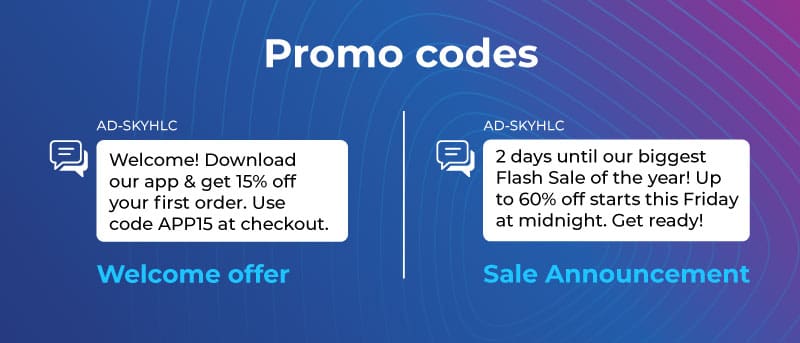
Many businesses use bulk SMS promotional messages to announce sales, launch products, and drive repeat purchases.
Bulk SMS advertising is particularly effective for flash sales, discount codes, and limited-time promotional offers.
Welcome Offer: Send newly acquired customers a special discount to encourage their first purchase and build brand loyalty from day one.
Example SMS: Welcome to Route Mobile! Enjoy 15% OFF on your first order with code WELCOME15. Valid until Sunday.
Sale Announcement: Inform customers about flash sales, limited-time discounts, and exclusive promotional events.
Example SMS: Flash Sale Alert! Get up to 40% OFF across selected products. Shop now before midnight.
To learn more about creating effective promotional campaigns, explore our beginner’s guide to promotional SMS for businesses.
Abandoned cart recovery
Abandoned Cart Reminder: Re-engage shoppers who added products to their cart but left without completing their purchase.
Example SMS: You left something behind! Complete your purchase today and enjoy free shipping. Checkout here: [link]
Loyalty & reward campaigns
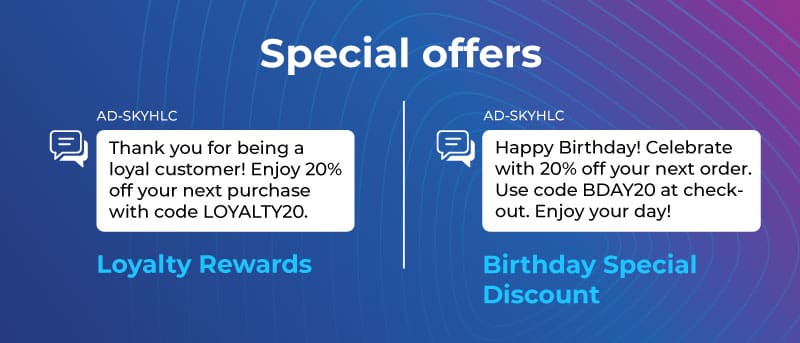
Loyalty Rewards: Notify customers when they have earned enough points to redeem a reward or unlock exclusive benefits.
Example SMS: Good news! You’ve earned 500 loyalty points. Redeem them now for exclusive rewards.
Birthday Special Discount: Celebrate customer birthdays with personalized discounts and special offers.
Example SMS: Happy Birthday, Sarah! Enjoy 20% OFF your next purchase. Use code BDAY20 today.
New product announcements
New Product Collection: Announce new product launches and encourage customers to explore or pre-order.
Example SMS: Introducing our latest collection! Be among the first to shop our new arrivals here: [link]
Seasonal & limited-time offers
Limited Edition Promotions: Create urgency around seasonal sales, festive campaigns, or limited-edition product launches.
Example SMS: Limited Edition Launch! Available for 48 hours only. Order now before it’s gone.
SMS drip campaigns
Educating on New Product: Send a sequence of SMS messages that guide customers through product features, onboarding steps, or usage tips.
Example SMS: Tip #1: Did you know you can automate reminders using our platform? Learn more here: [link]
Back-in-stock alerts
Re-stock Alert: Notify interested customers when previously unavailable products become available again.
Example SMS: Back by popular demand! The product you wanted is now in stock. Order now before it sells out.
Customer engagement bulk SMS use cases
Delivery updates
Delivery Update: Keep customers informed about shipping status and expected delivery timelines.
Example SMS: Your order #45678 is out for delivery and will arrive today between 2 PM and 6 PM.
Appointment reminders
Appointment Reminder: Reduce missed appointments by sending timely reminders with relevant details.
Example SMS: Reminder: Your appointment with Dr. Smith is tomorrow at 10:00 AM. Reply YES to confirm.
Two-way messaging & customer support
Sales Inquiries: Allow prospective customers to ask questions about products and services via SMS.
Example SMS: Reply to this message if you’d like to speak with our sales team about pricing or product options.
Customer Support: Enable customers to start SMS conversations with support teams for faster issue resolution.
Example SMS: Need help? Simply reply to this SMS and our support team will assist you.
Feedback surveys
Post-Purchase Survey: Collect customer feedback after a purchase to improve experiences and identify satisfaction levels.
Example SMS: Thank you for your purchase! We’d love your feedback. Complete our 1-minute survey here: [link]
FAQs
1. What is bulk SMS marketing?
Businesses often use the terms bulk SMS marketing and mass SMS marketing interchangeably. Bulk SMS marketing is the practice of sending text messages to a large group of recipients at the same time. Businesses use it to share promotions, offers, product updates, event invitations, reminders, and other time-sensitive information. Since SMS reaches customers directly on their mobile phones, it remains one of the most effective channels for customer engagement.
2. How does bulk SMS work?
Bulk SMS works through an SMS service provider that connects businesses to mobile networks. After uploading a contact list, creating a message, and selecting recipients, businesses can send thousands of messages simultaneously. Messages are delivered directly to customers’ mobile phones within seconds, making SMS ideal for time-sensitive communications and marketing campaigns.
3. What are the benefits of bulk SMS marketing?
The benefits of bulk SMS marketing include instant delivery, high open rates, strong customer engagement, personalization, and cost efficiency. These advantages help businesses communicate with customers more effectively while maximizing the return on their marketing efforts. Messages are delivered instantly, making them ideal for flash sales, limited-time promotions, appointment reminders, and urgent notifications. Businesses can also personalize messages using customer data, improving engagement and increasing the likelihood of conversions.
4. What features should I look for in a bulk SMS service?
When choosing a bulk SMS service, look for features such as high delivery rates, contact management, personalization, message scheduling, analytics, API integrations, two-way messaging, automated campaigns, and compliance tools. A reliable provider should also offer scalability, robust security, and global connectivity to support growing business needs.
5. How do I run a bulk SMS campaign?
Businesses learning how to do bulk SMS marketing should focus on audience segmentation, message relevance, timing, and performance tracking. To run a successful bulk SMS campaign:
- Define your campaign goal.
- Build a permission-based contact list.
- Segment your audience.
- Create a clear and concise message.
- Include a compelling call to action.
- Schedule or send the campaign.
- Monitor delivery, click-through rates, and conversions to optimize future campaigns.
6. How much does bulk SMS marketing cost?
Bulk SMS marketing costs vary depending on factors such as message volume, destination country, sender type, features, and service provider. Most providers follow a pay-per-message pricing model, while some offer volume-based discounts or subscription plans. Because of its low cost and high engagement potential, SMS marketing is considered one of the most cost-effective digital marketing channels.
7. Is bulk SMS marketing legal?
Yes, bulk SMS marketing is legal when businesses comply with local regulations and obtain customer consent where required. Most regions require businesses to collect opt-ins before sending promotional messages and provide a simple way for recipients to unsubscribe, such as replying with “STOP.” Regulations vary by market, including TCPA and 10DLC requirements in the US, DLT registration in India, and GDPR-related rules across Europe.
8. What’s the difference between bulk SMS, promotional SMS, and transactional SMS?
| Type | Purpose |
| Bulk SMS | A broad term for sending large volumes of messages to multiple recipients simultaneously. |
| Promotional SMS | Used for marketing campaigns, discounts, offers, product launches, and customer acquisition. |
| Transactional SMS | Used for service-related communications such as OTPs, account alerts, payment confirmations, and appointment reminders. |
In short, promotional and transactional SMS are both types of bulk messaging, but they serve different business objectives.
9. How can I improve bulk SMS deliverability?
To improve SMS deliverability, maintain a clean recipient list, send messages only to opted-in users, avoid spam-like language, personalise messages where possible, use registered sender IDs, and work with a trusted SMS provider that has strong operator connectivity. Monitoring delivery reports and regularly removing inactive numbers can also help maintain high delivery rates.
10. Is bulk SMS marketing profitable for businesses?
Yes. Bulk SMS marketing can deliver strong returns because it enables businesses to reach customers instantly through a highly accessible channel. Whether promoting products, driving traffic to websites, reducing missed appointments, or improving customer retention, SMS campaigns can generate measurable business outcomes while keeping marketing costs relatively low. Many businesses use bulk SMS as a core component of their customer engagement strategy due to its scalability, speed, and effectiveness.
Conclusion
Bulk SMS campaigns are undoubtedly an effective marketing and communication strategy for businesses. The massive open rates with SMS, convenience, ease of use, and direct messaging aspects of SMS and other contributors make them an unparalleled marketing practice to grow business exponentially.
Ready to get started? Explore Route Mobile bulk SMS marketing to deliver reliable, scalable, and secure messaging experiences worldwide. With features such as SMS APIs, A2P messaging, global connectivity, and advanced campaign capabilities, Route Mobile helps businesses maximize the impact of every message. You can also contact our experts to discuss your messaging requirements and find the right solution for your business.