Table of Contents:
In 2026, SMS continues to rank among the most effective customer communication channels, as reflected in the latest SMS marketing statistics. With open rates reaching up to 98% and response rates averaging 45%, it remains one of the most reliable ways for businesses to connect with customers in real time.
As global mobile usage expands and digital-first interactions become the norm, A2P messaging, SMS marketing, and RCS business messaging are now central to modern customer engagement strategies. Today, millions of businesses rely on SMS not just for promotions, but for critical use cases such as authentication, alerts, and lifecycle messaging driven by the need for faster, more secure, and highly personalized communication.
For businesses, it’s essential to stay ahead of the curve and be aware of the technological forecasts, trends, and current statistics predicting the future of marketing and communication. With this blog, picking the most fascinating SMS marketing trends and statistics, we’re doing the same for you.
Top SMS marketing trends & stats in 2026
SMS marketing has emerged as one of the most effective channels for real-time customer engagement. Its ability to deliver messages instantly, directly to a user’s mobile device, results in significantly higher visibility and interaction compared to other channels like email.
The key SMS marketing trends 2026 highlight why businesses continue to prioritize SMS as a core part of their customer communication strategy in 2026.
- 85.6% of consumers are subscribed to business SMS, reflecting high opt-in and channel trust.
- SMS drives strong engagement, with click-through rates of 21–35%.
- 82% of users check messages within five minutes, making SMS ideal for real-time communication.
- Businesses using SMS are nearly 6× more likely to achieve marketing success.
Resource links: https://www.mailmodo.com/guides/sms-vs-email-statistics/
These SMS marketing facts demonstrate why businesses continue to invest in SMS as a high-performance engagement channel.
How SMS drives ROI and conversions
SMS marketing delivers strong business outcomes, reinforcing its SMS marketing effectiveness, with ROI ranging from $21 to $41 for every $1 spent.
In terms of engagement, SMS continues to outperform email significantly:
SMS campaigns achieve click-through rates of 21–35%, while email remains more effective for long-form communication rather than immediate engagement and action.
These numbers make SMS ideal for time-sensitive, high-conversion campaigns such as promotions, alerts, and reminders.
Engaging customers via SMS
- 86% made repeat purchases via SMS in the past year.
- 26% of businesses are using SMS to send discounted offers to their customers to keep them updated.
- More than 50% of prospects make purchases after a marketing text.
- SMS remains widely used across industries for promotions, updates, and real-time engagement, making it a core customer communication channel.
These SMS marketing effectiveness metrics highlight the channel’s ability to drive strong engagement across industries.
Also Read: Top 10 SMS Marketing Best Practises For Businesses
AI-powered SMS marketing
- AI-driven messaging is enabling real-time personalisation, segmentation, and automated engagement at scale
- 64% of consumers are comfortable receiving AI-powered messages from businesses
- 52.5% expect clear disclosure when they are interacting with AI.
Fastest engagement
- 87% of consumers check a new text within 15 minutes, with 32% checking immediately.
- Nearly 70% of consumers expect a business to respond to their text within one hour.
- Texting is the preferred channel for 9 out of 10 business message types, including reminders, alerts, and confirmations.
- Consumers prefer text for appointment reminders (65%), account security updates (62%), emergency notifications (58%), and delivery confirmations (56%).
- 67% of consumers are more likely to purchase from a business whose texts they subscribe to.
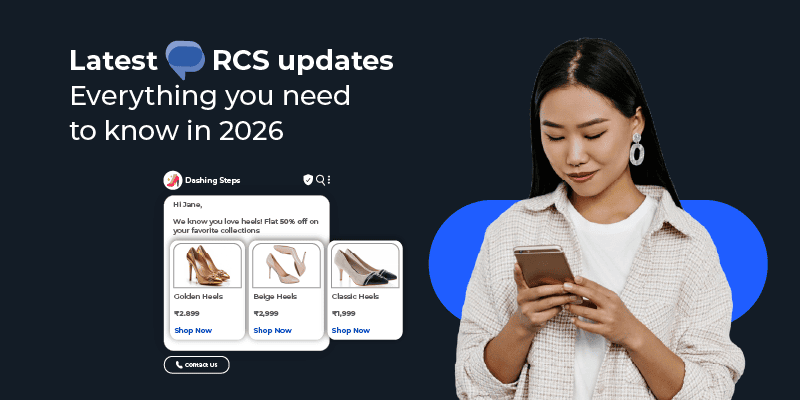
RCS: The next step in business messaging
- RCS is projected to reach approximately 3.8 billion users globally by 2026, covering nearly 40% of mobile subscribers.
- RCS campaigns can deliver 3–7x higher click-through rates compared to SMS, thanks to interactivity.
- RCS business messaging volumes reached around 50 billion messages globally in 2025, reflecting rapid enterprise adoption.
- RCS for business revenue is expected to reach around $2 billion globally in 2026, with strong growth projected ahead.
Personalized messaging at scale
- 93% of customers are more likely to return to buy more when they experience personalized customer service or experience.
- 62% of consumers believe that companies can do a better job personalizing their experiences.
SMS marketing within an omnichannel presence
- 89% of customers are more likely to buy from brands that deliver a seamless omnichannel experience, highlighting its direct impact on purchasing behavior.
Also Read: Why Omnichannel Customer Engagement Is the Future of Retail?
SMS use cases across key industries
- Ecommerce
SMS plays a critical role in driving revenue, with cart abandonment recovery via SMS averaging around 20–22%, making it a highly effective conversion tool. - BFSI (OTP & Alerts)
SMS is the backbone of secure transactions, with over 90% of financial institutions using SMS for OTP-based authentication and alerts. - Healthcare
SMS improves patient engagement and outcomes, with appointment attendance increasing by up to 67% when reminders are sent via SMS. - Retail & Customer Engagement
SMS is widely adopted for promotions and updates, with 68% of ecommerce and retail brands using SMS for campaigns and notifications.
Utilizing 10DLC numbers
95% of calls marked as “Spam Likely” go unanswered, highlighting the growing trust gap in business communications.
To address this, telecom operators introduced A2P 10DLC, a compliance framework that requires businesses to register messaging campaigns helping reduce spam, improve deliverability, and build customer trust.
In India, TRAI regulations mandate DLT (Distributed Ledger Technology) registration for all commercial SMS. Businesses must register sender IDs, templates, and consent, or risk message blocking by operators.
Solutions like Route Shield further enhance protection by helping businesses prevent spam, fraud, and grey-route messaging, while safeguarding brand reputation.
Future potential of SMS marketing
SMS is bound to skyrocket with the increasing number of mobile users, further expected to shoot up to 7.5 billion users by 2026.
60% of business owners believe their SMS marketing budget must be increased.
The global A2P and P2A messaging market is expected to exceed $92.8 billion in 2026, highlighting the rapid expansion of enterprise messaging for alerts, promotions, and customer engagement.
Conclusion
These SMS marketing trends and statistics will certainly revolutionize customer engagement strategy and marketing in 2024 and beyond. As a business, you must prioritize these listed aspects of text marketing, research, analyze, and discuss with relevant stakeholders to find ways to implement and adapt accordingly.
Optimizing SMS marketing today goes beyond traditional messaging. By integrating RCS business messaging and A2P messaging, businesses can deliver richer, more interactive, and highly scalable communication experiences across the customer lifecycle.
Partnering with experienced communication providers such as Route Mobile enables organizations to leverage advanced messaging solutions, enhance engagement, and ensure secure, reliable delivery at scale. Gaining an early mover advantage with these technologies can significantly strengthen your customer communication strategy.
FAQs
Is SMS marketing growing?
Yes, SMS marketing continues to grow steadily as businesses prioritize mobile‑first communication. With increasing global mobile usage and higher consumer opt‑ins, SMS remains a key channel for real‑time customer engagement across industries.
Why should businesses invest in SMS marketing?
Businesses should invest in SMS marketing because it delivers high engagement and direct reach. With open rates as high as 98% and response rates significantly higher than email, SMS is highly effective for driving customer engagement, improving retention, and increasing revenue.
What is considered a good conversion rate for SMS marketing?
A good SMS marketing conversion rate typically ranges between 21% and 30%, depending on the industry, campaign type, and audience targeting. High‑intent campaigns such as promotions or alerts often achieve even stronger results.
What is the ROI of SMS marketing?
SMS marketing delivers strong returns, with businesses generating between $21 and $41 for every $1 spent. Its high engagement and low cost make it one of the most efficient marketing channels for driving measurable revenue.
How does SMS compare to email marketing?
SMS consistently outperforms email in terms of engagement. It offers higher open, click‑through, and response rates, making it more effective for time‑sensitive communication, while email remains better suited for detailed, long‑form content.
What are the biggest SMS marketing trends in 2026?
Key trends shaping SMS marketing in 2026 include:
- AI‑powered personalization for more relevant messaging
- Lifecycle messaging replacing one‑way campaigns
- RCS business messaging enabling richer, interactive experiences
- Greater focus on compliance, security, and opt‑in engagement