Every match day, thousands of fans battle through app downloads, OTP failures, and sold-out loading screens. The problem isn’t demand. It’s friction.
For decades, the ticketing industry has been building more sophisticated solutions to a problem that was never about sophistication. Fans don’t need another app. They don’t need another account. They don’t need another password reset. They need a conversation.
The broken ticketing experience nobody talks about
Across live entertainment and sports, digital ticketing platforms lose a significant portion of potential buyers at each stage of the funnel, because the purchase journey is unnecessarily complex:
- Users abandon the flow when forced to create an account or download an app they’ll use once a year.
- Payment drop-offs spike when the checkout process involves multiple redirects or OTP timeouts.
- Last-mile issues: wrong email, unclear QR codes, no entry confirmation — create friction at the venue gate itself.
The behavioral shift that has already happened
WhatsApp is not new to transactions in India. While much of the world is still debating whether consumers will trust conversational commerce, Indian users have been quietly normalizing it for years.
We have begun to explore use cases that are not only digitally agile but also well-developed, addressing a wide range of needs and challenges that have previously been overlooked. This shift is particularly significant in our pursuit of enhancing digital convenience and prioritizing customer experience from the outset.
One such example is Delhi Metro ticketing on WhatsApp.
Delhi Metro (DMRC)
Commuters simply chat on their official WhatsApp number, select their route, and complete payment in a single chat. No app is required. No account registration. The metro ticket arrives as a scannable code within the same conversation. This easy ticket-booking interface eliminates offline booking challenges for Delhi Metro passengers, providing a seamless, hassle-free experience.
With 10 color-coded lines serving 256 stations, this efficient system is a gamechanger for commuters in the National Capital Region (NCR) of India.
Conversational platforms like WhatsApp are redefining how millions access public transport. Our (WhatsApp-ticketing) deployment across five metros (Delhi, Mumbai, Pune, Hyderabad, Nagpur) has driven 22 million conversations, integrating in-chat discovery and payments to serve 8.6 million commuters daily across 469 stations and 21 lines.
Holding the top share in payment APIs isn’t accidental; it’s the outcome of prioritizing native, seamless flows that now power over 3 million monthly tickets. This demonstrates how scalable tech can turn everyday friction into fluid experiences in bustling high-volume urban ecosystems. This has scaled across sectors and geographies, powering live bus ticket bookings in Bangladesh and now extending to ferry ticketing.
Source:
Enabled by Route Mobile Limited, Billeasy E Solutions Private Limited (Billeasy), PeLocal Fintech Private Limited, and Meta
These aren’t pilots. These are large-scale production deployments currently in operation, serving real users in sectors such as public transport and government, which are structurally similar to sports ticketing in every way that matters: high footfall, time-sensitive access, and UPI-native audiences.
What does this mean for live sports and entertainment?
Consider what the right sports property looks like for this use case. It tends to have a loyal, emotionally invested fan base that already uses WhatsApp daily. It manages multiple matches or events across a season, creating repeated touchpoints with the same audience. It sells tickets across price tiers, with upselling opportunities in food, merchandise, and premium seating. And critically, it currently captures very little first-party data about who its fans actually are.
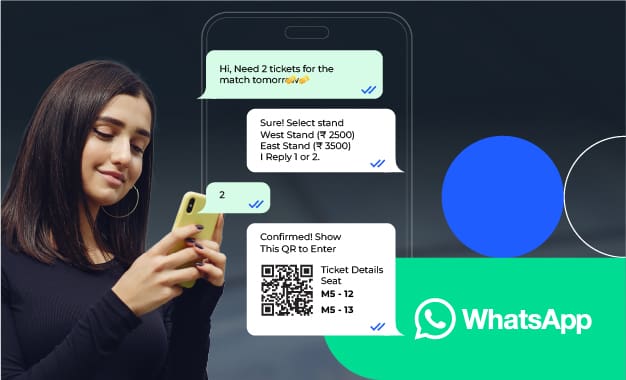
Now, picture the WhatsApp experience instead of the traditional one:
- A fan sees a match announcement shared in a WhatsApp group
- They tap a link or scan a QR code
- A chat opens. “Hello! Ready for the big match? Here are available seats.”
- They choose their seats and pay
- A QR code ticket lands in the same chat
- Two hours before the match, a reminder arrives: “Your match starts at 7 PM. Gate B opens at 5:30 PM.”
- At the gate, the steward scans the QR from the chat. Done.
When a fan purchases a ticket via WhatsApp, the sports property gains the relationship: the phone number, preference data, purchase patterns, and a direct line to re-engage for the next match.
Over a season, these compounds significantly. A club or league that deploys WhatsApp ticketing isn’t just solving a checkout problem. It is building a first-party fan database that cannot be taken away by a platform algorithm or a change in vendor relationships. It becomes the foundation for:
- Personalized match reminders and early-bird offers sent via broadcast, not algorithm
- Loyalty programs triggered by verified attendance history
- Targeted upsells for hospitality packages, merchandise, and season passes
- Direct communication channels that function during sold-out spikes when third-party platforms slow down
Why WhatsApp wins at scale?
The final argument is structural. WhatsApp’s penetration in India is not a demographic phenomenon. It cuts across age, income, and geography in a way that no single app can match. A fan in their 50s attending a cricket match of one format and a 19-year-old watching another format are equally likely to have WhatsApp as their most-used communication tool.
When a ticket link is shared via WhatsApp in a family group, a college group, or a corporate group, it follows the natural pattern of how Indians plan social outings. The purchase channel becomes part of word of mouth itself. That is a distribution advantage that no standalone app can replicate organically.
Understanding the practical application of WhatsApp ticketing
For those wondering what the technical journey looks like, it is simpler than most assume. A well-built WhatsApp ticketing deployment follows five stages:

Every step above is technically possible today using WhatsApp Business API, a capable CPaaS partner, and a payment gateway with UPI support. The infrastructure exists. What is needed is the will to simplify.
The teams and leagues that understand this now won’t just sell more tickets. They’ll build something far more valuable: a direct, trusted, real-time relationship with the people who love them most.