Table of Contents:
- Why CPaaS is becoming a strategic business priority
- How CPaaS is evolving beyond messaging
- The growing role of AI in customer engagement
- Why security and trust matter more than ever
- Who are Gartner Magic Quadrant Leaders
- Key considerations when choosing a CPaaS provider
- How Proximus Global is helping shape the future of customer engagement
Customer communication is far more complex today.
Businesses are under pressure to improve efficiency, strengthen security, and find new ways to scale engagement. AI is accelerating these expectations, requiring communications platforms to support more intelligent and connected customer journeys.
Against this backdrop, Communications Platform as a Service (CPaaS) is evolving from a communications enabler into a strategic orchestration layer. For multinational enterprises, this means combining global infrastructure with local expertise, regulatory knowledge, and market-specific channel preferences.
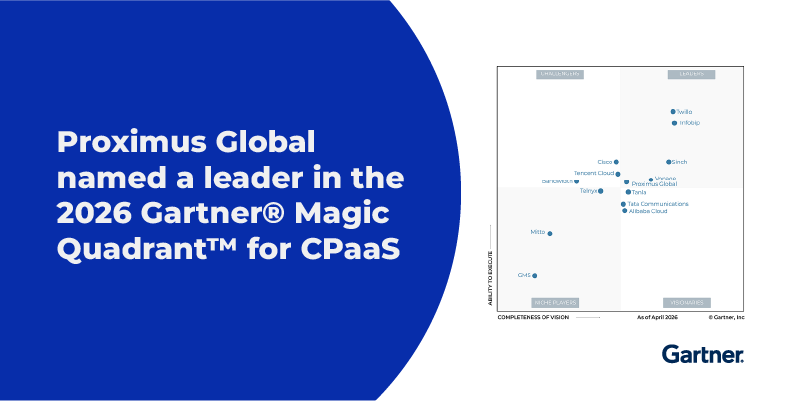
We’re bringing our takeaways from the Gartner 2026 Magic Quadrant for CPaaS report where Proximus Global is recognized as a Leader. We believe this reflects many of the capabilities that enterprises are increasingly prioritizing as customer engagement becomes more intelligent, connected, and secure.
Why is CPaaS becoming a boardroom conversation?
Not long ago, communications were often treated as separate functions within the business. Marketing teams managed campaigns, customer service teams handled support interactions, and digital teams focused on websites and apps.
Today, those experiences are expected to work together.
This is one reason CPaaS has gained strategic relevance. Organizations are increasingly looking for ways to connect communications across channels, automate engagement, and create more cohesive customer journeys.
Consider a bank onboarding a new customer. Identity verification, account setup, transaction alerts, support interactions, and ongoing engagement all need to work together. What was once a series of disconnected communications is now expected to feel like a single, continuous experience.
For global enterprises, the challenge is even greater: the same customer journey may need to adapt across local identity requirements, fraud risks, data residency expectations, language preferences, and market-specific communication rules.
The conversation around CPaaS has therefore shifted. It is no longer just about enabling messages or calls. It is increasingly about enabling better customer experiences and supporting broader digital transformation goals.
Is CPaaS still just about messaging?
Messaging remains the foundation of CPaaS, but it is no longer the whole story.
Most leading providers offer access to a wide range of communication channels. The real challenge is ensuring those channels work together effectively.
Organizations want to maintain context as customers move between channels. They want interactions to feel connected rather than fragmented. They also want to deliver communications that are timely, relevant, and informed by customer behavior.
This is why we feel Gartner places significant emphasis on orchestration, personalization, and customer engagement capabilities.
For an airline, that could mean connecting booking confirmations, check-in reminders, gate updates, and customer support into a single journey rather than treating each communication as a separate interaction. The value comes not from sending more messages, but from creating a better experience around them.
The market is increasingly moving from channel-centric communications to customer-centric engagement. Success depends on maintaining context and continuity as customers move between channels and touchpoints.
Why is AI becoming central to CPaaS?
If there is one theme that appears consistently throughout the CPaaS market today, it is AI.
Providers are investing heavily in conversational AI, intelligent automation, personalization, customer journey optimization, and agent-assisted experiences. What makes this shift noteworthy is that AI is becoming embedded across the communications stack rather than existing as a standalone capability.
The next phase of customer engagement is moving beyond chatbots and simple automation. Enterprises are beginning to explore AI for assisting agents, triggering workflows, summarizing context, routing conversations, and coordinating actions across customer journeys.
For enterprises, this creates new opportunities to improve both customer experience and operational efficiency.
A telecom provider, for example, may use AI to resolve common service requests automatically while routing more complex issues to the right specialist with full conversation context. The customer receives a faster resolution, while the business reduces pressure on support teams. CPaaS providers can play a practical role by connecting AI capabilities to customer communication channels, enabling secure handoffs to human agents, and embedding AI into trusted engagement workflows rather than treating it as a standalone chatbot.
The broader implication is that organizations are beginning to evaluate communications platforms not only on their connectivity capabilities, but also on how intelligently they can support customer interactions.
As enterprises adopt agentic AI, communications platforms will increasingly need to support autonomous workflows, secure decision-making, and trusted interactions across channels.
Why are security and trust becoming strategic priorities in customer communications?
As digital engagement grows, trust has become a critical competitive advantage.
Organizations face growing challenges related to fraud, identity verification, compliance, and customer privacy. At the same time, customers are becoming more cautious about the messaging they receive and the brands they choose to engage with.
This helps explain why security features are becoming increasingly prominent within the CPaaS market.
In banking and financial services, for instance, trusted and verified communications can play an important role in reducing fraud while strengthening customer confidence. Similar expectations exist across industries where customer data, privacy, and compliance are critical considerations.
Increasingly, security is no longer viewed as a supporting capability. It is becoming a core part of the customer experience itself.
As customer engagement becomes increasingly digital, organizations need stronger mechanisms for identity verification, fraud prevention, compliance, and secure communications.
Who are Gartner Magic Quadrant Leaders?
Leaders are in the strongest position to influence the market’s direction. They demonstrate a market-defining vision of how CPaaS can be deployed in various use cases. Leaders have the Ability to Execute against that vision through the capabilities of their organization, business model and platform. They have demonstrated business results in the form of customer feedback and growth. They excel in their combination of market understanding, innovation, platform features and overall viability. We are recognized for our ability to execute and completeness of vision.
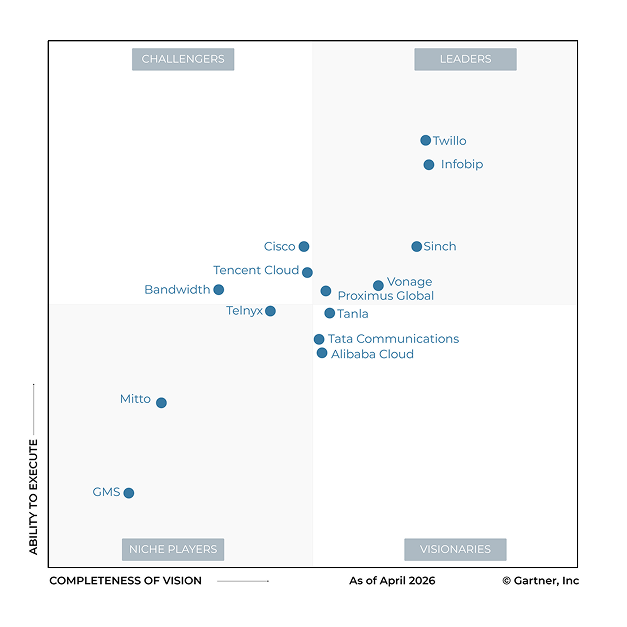
In our opinion Proximus Global’s placement in the Leaders Quadrant reflects many of the priorities shaping the market today. Its focus on global communications, omnichannel engagement, security, and continued innovation align closely with the direction Gartner sees the CPaaS market moving.
More broadly, we feel the report reinforces the idea that enterprises are increasingly looking for long-term strategic partners rather than providers that simply offer communications channels.
What should organizations look for when evaluating a CPaaS provider?
As CPaaS becomes more strategic, provider selection becomes more important.
While communication channels and pricing remain important considerations, Gartner’s findings suggest organizations should take a broader view.
Questions worth asking include:
- Can the platform support engagement across multiple channels while maintaining context?
- How effectively can the platform combine AI, automation, customer context, and trusted engagement across the customer journey?
- Does it provide the security, compliance, and fraud prevention features your business requires?
- Can it support both local market requirements and global growth ambitions?
- Does its roadmap align with where customer engagement is heading?
The answers will naturally vary by organization. A retailer preparing peak shopping periods may prioritize scalability and customer engagement, while a hospitality brand may focus on creating seamless guest experiences across booking, stay, and loyalty journeys.
The key is to evaluate providers based on the outcomes your business is trying to achieve, not simply the channels they support.
Powering the next generation of customer engagement
As customer engagement becomes more intelligent, connected, and secure, organizations need communications partners that can help them keep pace with changing customer expectations. We believe the 2026 Gartner Magic Quadrant for CPaaS highlights several priorities shaping the market, including global reach, trusted communications, omnichannel engagement, AI-driven innovation, and continued investment in emerging technologies.
By bringing together the strengths of Route Mobile, BICS, and Telesign, Proximus Global combines global communications, digital identity, and customer engagement capabilities to help enterprises build trusted, connected experiences across every stage of the customer journey.
This combination is especially relevant for multinational enterprises that need to scale globally while adapting locally: navigating market-specific regulations, customer communication preferences, data residency requirements, and localized support needs.
Together, these capabilities help organizations:
- Connect with customers worldwide through carrier-grade communications infrastructure
- Strengthen trust with advanced identity, verification, and security solutions
- Deliver more relevant and personalized customer experiences
- Scale customer interactions reliably across markets, regions, and customer touchpoints
- Adapt to emerging technologies and evolving customer expectations with confidence
Whether you’re modernizing customer communications, improving customer experience, or planning for the next phase of digital transformation, understanding how the CPaaS market is evolving is an important first step.
Explore the 2026 Gartner® Magic Quadrant™ for CPaaS and learn why Proximus Global was recognized as a Leader.
Disclaimer:
Gartner and Magic Quadrant are a trademark of Gartner, Inc., and/or its affiliates.
Gartner does not endorse any company, vendor, product or service depicted in its publications, and does not advise technology users to select only those vendors with the highest ratings or other designation. Gartner publications consist of the opinions of Gartner’s business and technology insights organization and should not be construed as statements of fact. Gartner disclaims all warranties, expressed or implied, with respect to this publication, including any warranties of merchantability or fitness for a particular purpose.
This graphic was published by Gartner, Inc. as part of a larger research document and should be evaluated in the context of the entire document. The Gartner document is available upon request from Proximus Global.