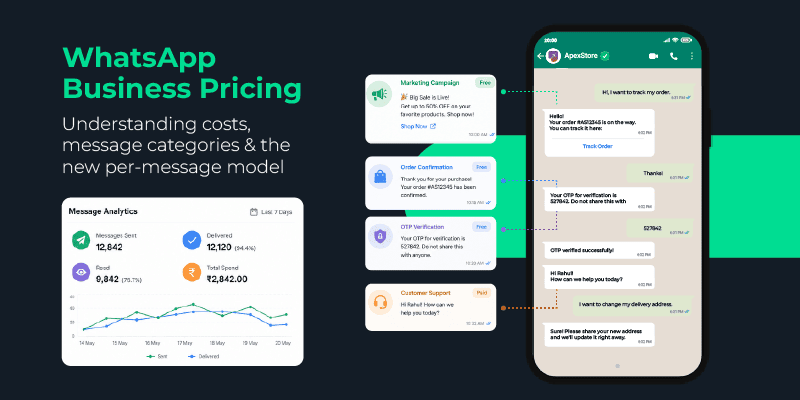
If your WhatsApp Business API bill has looked different since mid-2025, there’s a good reason for it. On July 1, 2025, Meta retired conversation-based pricing (CBP), the model that charged businesses once per 24-hour messaging window, and replaced it with per-message pricing (PMP), where every delivered template message is billed individually.
This is not a small tweak. It changes how you should think about budgeting, how you design your message templates, and how much your business solution provider (BSP) actually costs you.
If you are trying to understand what WhatsApp business pricing looks like today, or you are comparing WhatsApp Business API pricing across providers, this guide walks through the full picture: what is free, what is not, how the four message categories are billed, and how to bring your costs down without cutting corners on customer experience.
Is WhatsApp business free?
The short answer is: it depends on which WhatsApp product you mean.
WhatsApp Business App, a free application available for download from app stores and designed for small businesses, is free to use and does not have a pricing model.
WhatsApp Business Platform, often referred to as the WhatsApp Business API, is a paid solution designed for larger enterprises. It operates on a usage-based pricing model, where charges apply based on message volume beyond WhatsApp’s free messaging allowances.
That said, a meaningful share of your messaging can still be free even on the API. Service replies, utility templates sent inside an open service window, and messages sent through free entry points like Click to WhatsApp ads can all be free (full breakdown below).
So the honest answer is that the business app is free, the API is not, but a well-designed conversation flow can still keep a large portion of your API traffic at zero cost.
WhatsApp business products and their pricing model
| WhatsApp Business App | WhatsApp Business Platform (API) | |
| Who it’s for | Small businesses, solo operators | Mid-size to enterprise businesses |
| Cost | Free | Usage based, per delivered message |
| Users | One phone, one user | Multiple agents, integrates with CRM/CCaaS |
| Automation | Basic auto-replies, catalog | Chatbots, templates, Flows, webhooks |
| Access | Direct app download | Through a business solution provider |
This article focuses entirely on WhatsApp Business Solution built on the WhatsApp Business Platform, which is what most growing businesses eventually move to once they need multiple agents, automation, or integration with existing systems.
What changed on July 1, 2025: from conversation-based to per-message pricing
Before July 2025, WhatsApp billed businesses per 24-hour conversation. Sending one template message opened a conversation window, and every additional message of that same category sent within that window was bundled into the same charge, regardless of how many messages you actually sent.
From July 1, 2025 onward, that bundling is gone. You are billed for every delivered template message individually, based on its category and the recipient’s country calling code. Meta framed the shift as an alignment with how most other paid messaging channels are billed, and as a way to make volume forecasting more predictable for businesses running large campaigns.
The change did not happen all at once. It arrived in stages:
- November 2024 — WhatsApp removed the cap on free service conversations, so customer-initiated support conversations became unlimited and free.
- July 1, 2025 — Utility template messages sent inside an open service window became free as part of the per-message pricing roll out.
- January 1, 2026 — Meta introduced local currency billing for eligible businesses in India, so qualifying accounts are now billed in INR rather than USD.
The practical effect is that your WhatsApp business API cost is now driven almost entirely by how many template messages you send and which category they fall into, not by how many separate 24-hour windows those messages happened to land in.
The four WhatsApp business API message categories
Every business-initiated message sent through the WhatsApp Business Platform falls into one of four categories, and each is billed differently.
| Category | What it’s for | Paid or free |
| Marketing | Promotions, offers, re-engagement campaigns | Always charged per message |
| Utility | Order confirmations, shipping updates, appointment reminders | Charged per message outside a service window; free inside one |
| Authentication | OTPs, login verification, MFA codes | Always charged per message; some countries carry a separate authentication-international rate |
| Service | Customer support replies within 24 hours of a customer message | Always free |
Marketing messages are the most expensive category almost everywhere, since they are promotional by nature and are never eligible for the free service-window exemption.
Authentication messages, mostly OTPs and verification codes, are generally the cheapest per-message category on WhatsApp Business Platform. However, nine markets carry a separate, higher authentication international rate: India, Egypt, Indonesia, Malaysia, Nigeria, Pakistan, Saudi Arabia, South Africa, and the United Arab Emirates.
This rate isn’t about how the message is routed. It’s about where the sending business is registered relative to the recipient, and it only applies once a business crosses a defined volume threshold in these markets. Further details are covered below under special pricing scenarios.
Utility is the category that benefits most from the July 2025 change, since it’s the only paid category that can also ride the free service window (see below).
WhatsApp Business API pricing: how much does it actually cost?
There is no single global price for WhatsApp business API. Meta prices each message based on two things: its category (marketing, utility, or authentication) and the recipient’s country calling code, not the country the business is sending from.
Meta raised India’s marketing rate about 10% on January 1, 2026, from ₹0.7846 to ₹0.8631, while Utility and Authentication held roughly stable around ₹0.115. India remains the cheapest major market by a wide margin. For context, the same Marketing category runs $0.025 in the US and climbs to $0.13-0.14 in Germany or France, versus India’s fraction-of-a-cent equivalent.
A few things worth keeping in mind before you try to model your costs:
- Pricing is set per country calling code, so where your recipients are, not where your business is registered, determines the rate.
- Meta updates rates periodically, sometimes as often as quarterly, and recent updates have touched markets including India, Colombia, Mexico, the UAE, Saudi Arabia, and several European countries.
- Because rates move, the only reliable source for current pricing is Meta’s official WhatsApp Business Platform rate card, which any budgeting exercise should be checked against directly.
That gap between Marketing and the other two categories is consistent across markets, though the multiple varies; always check Meta’s current rate card for exact figures.
What’s still free on the WhatsApp Business Platform
Even under the new per-message model, a meaningful amount of WhatsApp Business Platform activity remains free:
- All service conversations, meaning any reply you send to a customer within 24 hours of them messaging you first.
- Utility templates sent inside an open service window.
- Any non-template message (plain text, images, documents, and so on) sent inside a service window.
- Messages sent through the Click to WhatsApp Ads free entry point, for 72 hours after the customer starts the conversation.
- Messages sent through a Facebook Page call-to-action free entry point, also for 72 hours.
Businesses that lean on customer-initiated conversations and design their flows to reply with utility templates while a window is open can keep a large share of their messaging cost-free, even at meaningful volume.
Volume tiers and how to unlock lower rates
Meta offers volume-based discounts on utility and authentication messages once a business crosses certain monthly thresholds. A few details matter here:
- Tiers are set per market and per category, not aggregated across your whole account globally, so hitting a high volume in India does not lower your rate in Brazil
- Tiers reset monthly
- Volume is aggregated across all WhatsApp Business Accounts (WABAs) within the same business portfolio, so a business running multiple WABAs under one portfolio can combine volume to reach lower tiers faster than if those accounts were siloed
- Discounts apply incrementally: only messages sent after you cross a threshold receive the lower rate, not your entire month’s volume retroactively
For a business sending a large volume of order confirmations or OTPs in a single market, structuring accounts to consolidate volume within one portfolio can meaningfully lower the effective per-message rate over a full month.
Special pricing scenarios
A handful of situations do not fit neatly into the standard rate card, and it’s worth knowing about them before they show up as a surprise on an invoice.
Authentication-international rates. In the nine markets stated above, businesses are billed a separate, typically higher authentication rate under specific conditions.
This rate isn’t tied to how the message is routed. It’s tied to where the sending business is registered relative to the recipient. A business only qualifies for the higher rate once it crosses 750,000 authentication messages outside customer service windows within a rolling 30 day period, sent to unique users in these nine countries (India, Egypt, Indonesia, Malaysia, Nigeria, Pakistan, Saudi Arabia, South Africa, and the United Arab Emirates).
Once a business crosses that threshold, Meta sets country specific start dates 30 days out and notifies all account admins by email before the higher rate applies. Eligibility, once triggered, is permanent.
India is a useful case for understanding how this plays out, since it sits on both sides of the equation. A business based in India sending OTPs to any of the other eight markets pays the international rate on those messages once eligible.
At the same time, any foreign business sending OTPs into India pays India’s international rate too, since domestic pricing only applies when the sending business and the recipient share the same country.
Currency billing localization. As of January 1, 2026, eligible businesses with India as their billing country can be billed directly in INR instead of USD. Existing USD-billed accounts don’t automatically convert to INR; historically, this meant creating a new WABA with INR selected at setup.
Meta has since introduced WABA Currency Migration APIs (available from June 1, 2026) to streamline this process. Meta requires all WABAs in an eligible business portfolio to be migrated to INR by December 31, 2026, after which non-INR WABAs in eligible accounts will stop having their messages delivered. Brazil is expected to move to BRL billing later in 2026.
Marketing Messages API (MM API) is a delivery mechanism, not a separate pricing category. It sits inside the existing Marketing category and uses the same pricing as standard Cloud API marketing messages. On rate cards, MM API shows up as a distinct line item, typically labeled “WhatsApp Marketing Lite Conversation” on usage statements, even though the rate multiplier matches standard Marketing.
WhatsApp Business Calling API runs on its own separate rate card from the four message categories, though call permission request templates are still billed under standard message pricing. All user-initiated calls are free, regardless of duration or country. Only business-initiated calls are billed.
Call duration is billed in six-second pulses (a 56-second call rounds up to 10 pulses). Call recording and transcription are free for now, with paid pricing planned for a future undated release.
Free entry points have edge cases. The 72-hour free window only applies to the specific customer who clicked the ad or CTA button, and the clock starts from their first message, not from when the ad was clicked.
WhatsApp chatbot pricing: what it actually costs
WhatsApp chatbot pricing layers two costs: Meta’s per-message rate (as above) plus your BSP or platform’s own fee (see FAQ).
Since service-window messaging is free regardless of who’s replying (see above), a chatbot answering customer-initiated messages inside that window can run at zero WhatsApp messaging cost; the BSP or platform fee for running the bot is the only cost left standing.
How you design the bot’s conversation flow affects cost too, the same template-consolidation logic covered below in cost-reduction strategies applies directly to bot-generated messages.
WhatsApp business cost by use case
Costs look very different depending on how a business actually uses the platform. A few common patterns:
- E-commerce order confirmation flow: mostly utility messages, many landing inside an open service window, so a good share of this flow is free.
- BFSI OTP delivery: almost entirely authentication messages, though banks and lenders sending high volumes to markets with uthentication-international rates should budget those separately.
- Marketing campaign to 100,000 contacts: entirely marketing category messages, with no service window to offset cost, making this the most expensive use case per message sent.
- Customer support-heavy operation: mostly service messages, which stay largely or entirely free.
The clearest takeaway across all four patterns: reactive usage (replying to customers) costs less than proactive usage (initiating outreach), a pattern worth designing for; more on that below.
How to reduce WhatsApp Business Platform costs
A few practical levers consistently bring costs down without compromising the customer experience:
- Design multi-info templates. Combine related information into one richer template rather than sending several small ones back to back.
- Prioritize customer-initiated flows. Encourage customers to message first, whether through QR codes, website widgets, or WhatsApp links, since that opens a free service window you can use for utility templates.
- Use Click to WhatsApp Ads to open a 72-hour free window for new customers, rather than relying solely on paid outbound templates.
- Consolidate on utility templates inside service windows wherever the use case allows it.
- Categorize templates correctly. A utility message miscategorized as marketing (or vice versa) can affect both cost and approval, so template classification is worth getting right the first time.
- Use volume tiers strategically by consolidating WABAs under one business portfolio where possible, so volume-based discounts kick in sooner.
Route Mobile’s guide to WhatsApp automation use cases and its WhatsApp Flows go deeper into template consolidation and automation design if you want to take this further.
FAQs
Is there a monthly minimum on WhatsApp Business API?
Meta itself does not impose a message minimum, though individual BSPs may have their own minimum commitments or platform fees.
Do I pay Meta directly or through a BSP?
Access to the WhatsApp Business Platform requires going through an authorized BSP. Meta’s per-message rate is the same regardless of BSP, but the BSP typically adds its own platform fee or markup on top.
Are incoming messages charged?
No. Only outbound, delivered business-initiated template messages are billed. Messages customers send to you are free to receive.
What counts as a “delivered” message for billing?
A message is only charged once WhatsApp confirms delivery. Undelivered messages, such as those sent to invalid or unreachable numbers, are not billed.
How does WhatsApp pricing compare to SMS?
In most markets, WhatsApp’s utility and authentication rates are competitive with, or cheaper than, SMS, and WhatsApp typically sees meaningfully higher read rates, which improves the effective cost per successful interaction even where the per-message price is similar.
Does Route Mobile add fees on top of Meta’s rates?
As a BSP, Route Mobile applies a platform fee alongside Meta’s underlying per-message rate, in the same way any BSP does. For a clear breakdown of what that looks like for your specific volume and markets, it’s worth talking to the team directly.
Getting your WhatsApp pricing strategy right
The move to per-message pricing rewards businesses that design their WhatsApp strategy deliberately: encouraging customers to start conversations, batching information into fewer, richer templates, and understanding exactly which category each message falls into before it goes out. Get that right, and WhatsApp business pricing becomes a lot more predictable than it looks at first glance.
If you want a clearer read on what your specific message volume and markets would actually cost, get in touch with us to talk through your use case.