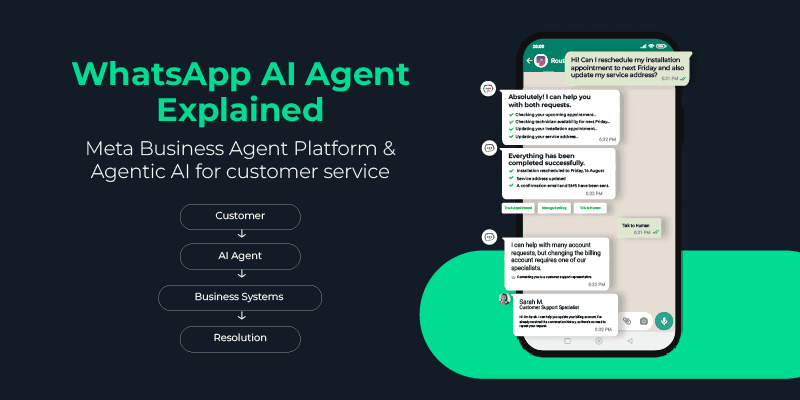
Agentic AI in customer service just got its biggest consumer platform yet. At Conversations 2026 event, Meta introduced its WhatsApp AI agent, Meta Business Agent Platform (Agentic AI) that lets businesses respond to every customer as if they had an infinite team behind them, alongside a global launch across WhatsApp, Instagram, and Messenger.
For CX teams, this isn’t a minor feature update. It’s Meta repositioning WhatsApp as workflow software, not just a messaging channel.
What is agentic AI in customer service?
Agentic AI is an autonomous system that handles conversations and performs tasks for enterprises based on user requests, with the ability to make adaptive, goal-oriented decisions.
For customer interaction platforms, this is the opportunity: agentic AI doesn’t just answer questions. It acts, booking, refunding, qualifying, escalating, without a human triggering each step. That’s what separates it from a decade of scripted chatbots. Chatbots follow rules. Agentic AI reasons across context and calls other systems on its own.
This is why agentic AI for customer service is on every major CX platform roadmap this year. And WhatsApp, with 3 billion users already messaging businesses on it, is where the shift will be most visible first.
What Meta’s WhatsApp AI agent does
Meta Business Agent is the consumer facing layer of this shift. No-code chatbots have handled two-way conversations on communication platforms for years, this is the next step in that evolution.
More importantly, agentic messaging also covers agent-to-agent communication, where agents across different use cases coordinate toward a common goal.
The AI agent for WhatsApp answers customer questions, recommends products from a catalog, books appointments, qualifies sales leads, and completes transactions, then hands off to a human when a conversation needs one. It runs natively across WhatsApp, Instagram, and Messenger, no separate app or developer setup required. TechCrunch
A few CX-relevant capabilities worth calling out:
- Escalation logic: a handoff mechanism routes the conversation to a live employee once it crosses a threshold the business defines.
- Overnight briefings: the AI agent can send owners a morning summary of overnight chats along with key trends, which functionally replaces a chunk of what a night shift support queue would otherwise need.
- Full control layer: businesses set who the AI agent talks to, what it knows, and what topics it must always escalate rather than answer itself.
The enterprise layer: Meta Business Agent Platform
This is the bigger deal for larger CX operations. The Meta Business Agent Platform gives enterprises the infrastructure to build, customize, and deploy their own Business AI Agent at scale, connecting to hundreds of systems like Shopify and Zendesk so the agent can take action on the business’s behalf. It runs alongside the existing WhatsApp Business Platform rather than replacing it, and includes enterprise-grade controls, guardrails, and measurement. Whatsappbusiness
Adoption is already real, not hypothetical. Pilots in India, Mexico, and Brazil produced an installed base of over one million businesses on WhatsApp and Messenger before the global rollout. And the India angle is direct: Meta announced the platform at its third Business Summit in Mumbai, with early enterprise adopters including Swiggy, Madhulika Enterprises, and Kaizen Adventours. Swiggy’s framing is a useful CX data point on its own: the company is using the agent to bring delivery partner onboarding into WhatsApp, aiming for a faster, more familiar journey for users already on the platform. finance.yahoo
What this means for CX teams
- The support queue shrinks, but the escalation queue gets more complex. Simple, repetitive questions get absorbed by the AI agent. What lands with human agents will skew toward edge cases, meaning your team needs better handoff context, not just fewer tickets.
- CX becomes a configuration job, not just a response job. Knowledge control, personality control, audience control, and handoff control are all business-side settings. Someone on the CX or ops team now owns tuning the agent, not just staffing it.
- Measurement expectations shift. With enterprise-grade guardrails and measurement built into the platform, leadership will expect CX dashboards to show AI agent resolution rates, handoff triggers, and where the AI agent underperforms, similar to how you’d track a live team.
- This sits on top of your existing WhatsApp Business Platform, not instead of it. For teams already running conversations through a CPaaS partner, the AI agent layer adds a decision point: what stays with your existing automation and BSP tooling, and what gets ceded to Meta’s native agent.
- Pricing is coming, and it is usage-based. Meta plans to charge for the agent through WhatsApp Business Premium tiers, with larger businesses billed by token usage, and access is free for now with tiered pricing expected within the next several months. Budget conversations should start before that lands, not after.
Meta Business Agent Platform vs BSP-deployed agentic AI
The agentic AI platform landscape for WhatsApp splits into three tiers: Meta’s self-serve Business Agent (free, native, no integrations), Meta’s invite-only enterprise Business Agent Platform (like Shopify/Zendesk/Shopee), and BSP-deployed agentic AI like Route Mobile (available now, full CRM/legacy system integration, predictable pricing).
Meta Business Agent is free for now, but Meta has confirmed usage-based, token-metered pricing is coming for larger businesses. BSP pricing is already known and predictable: a platform fee plus Meta’s separate WhatsApp API messaging fees, a structure businesses already budget for.
WhatsApp agentic AI options compared: Meta vs BSP-deployed
| Feature | Meta Business Agent (Self-Serve) | Meta Business Agent Platform (Enterprise) | BSP-Deployed Agentic AI (Route Mobile) |
| Availability | Live now, free | Invite-only, waitlist | Live now, standard plan |
| Primary Focus | Out-of-the-box AI for basic FAQs, bookings, leads | Enterprise automation with app-level integrations | Fully custom, complex agentic workflows for large enterprises |
| CRM Integration | None — single-operator inbox | Live with Shopify, Zendesk, Shopee for now | Supports integration with leading CRM platforms |
| Customization | Standardized, trained on catalog/FAQs | Standardized with basic API access | Highly customizable — proprietary AI, localized logic |
| Data Control | Processed on Meta’s servers | Processed on Meta’s servers | Can be hosted on private infrastructure for data residency compliance |
| Platform Scope | WhatsApp, Instagram, Messenger only | WhatsApp, Instagram, Messenger only | Can integrate non-Meta channels into one omnichannel inbox |
| Setup & Support | Self-serve, no developer needed | Self-serve via Meta Business Suite | Managed by BSP with custom development and SLAs |
Case study highlights from Meta
At the Mumbai Business Summit, three early adopters gave a clearer picture of B2B use cases:
- Swiggy used the platform to bring delivery partner onboarding into WhatsApp, aiming to make a multi-step operational process feel as familiar as a chat.
- Kaizen Adventours used it to handle high-volume inquiry categories (pricing, itineraries, availability) during peak season, freeing the team to focus on conversion rather than repetitive first-response work.
- Madhulika Enterprises saw a 25%–30% increase in sales conversions and automated 50%–60% of customer inquiries as an early adopter of the Meta Business Agent Platform on WhatsApp.
Metrics businesses should track now
Move measurement past “response time” and “messages handled.” What agentic changes is the shape of the metrics that matter:
- Resolution rate, not response rate — the percentage of conversations the agent actually closes without human intervention, not just replies to. This is the number that tells you if the agent is working or just buying time.
- Escalation quality, not escalation volume — track what percentage of human handoffs come with clean context versus a customer having to repeat themselves. A high handoff rate isn’t automatically bad if the context transfer is clean.
- Correction to improvement lag — how long between an agent giving a wrong answer and that correction actually changing future behavior. This is new because it didn’t exist as a metric for rule-based bots.
- Action completion rate — for agents wired into CRM, catalog, or order systems, track how many conversations resulted in a completed action (booking, refund, order update) versus just an accurate answer. This is the metric that separates an agent from a chatbot in your reporting, not just in your marketing copy.
- Lead qualification accuracy — for B2B specifically, track how often agent qualified leads convert versus human qualified leads, piloting on a limited campaign set and measuring pre-qualified lead rate alongside direct sales feedback on lead quality before scaling.
Should you skip chatbots entirely: no, with conditions
Skipping straight to agentic AI isn’t right for every business, and framing it as an either/or misses the actual decision. The honest answer is scenario dependent.
When rule-based chatbots still make sense
- Low volume, highly repetitive queries. If you’re getting under 50 daily queries and they’re mostly the same handful of questions, a rule-based bot is enough. Agentic AI adds cost and complexity you won’t recoup.
- Strict compliance environments. Rule-based flows are auditable by design, since every path is predefined. In regulated categories like finance or healthcare, that predictability can be a feature, not a limitation, until agentic guardrails mature further.
- Early stage businesses with no CRM or system integrations yet. An AI agent’s value comes from connecting to systems and taking action. Without a CRM, order system, or catalog to plug into, you’re paying for capability you can’t use yet.
When you should skip straight to agentic AI
- High volume, high variance queries. If questions are varied and don’t fit a script, rule-based bots fail constantly and push everything to human agents anyway, defeating the purpose.
- You need action, not just answers. Order status changes, appointment booking, refund processing. If resolution requires touching a system, a chatbot is never going to solve this regardless of how well it’s built.
- B2B with long, multi-touch conversations. Enterprise buying involves multiple stakeholders and back and forth over time. A scripted bot can’t hold that context across sessions. An agent that retains conversation history and reasons across it can.
- You’re already running a bot and hitting its ceiling. If your current setup has a high escalation rate on queries that feel like they should be automatable, that’s the signal the architecture, not the training, is the problem.
Onboarding agentic AI for B2B enterprises: a phased approach
Massive CX engagement doesn’t start with a full rollout. It starts narrow and expands once trust is earned internally.
Phase 1: Scope and connect one system, not everything
Pick a single high value integration first, CRM or order management, not both. Meta’s enterprise onboarding runs through the API path specifically to connect the agent to CRM, ecommerce platforms, or internal databases, but that flexibility requires technical setup, so start with the integration that has the clearest ROI case, not the most ambitious one.
Phase 2: Set knowledge boundaries before launch
Feed it the specific, current knowledge base: catalog, pricing, policies, past resolved chat transcripts. Just as important, define what it should never answer. Guardrails like never promising a discount or never revealing sensitive information should exist before the first real customer conversation, not after an incident.
Phase 3: Set the handoff threshold deliberately, then tune it
Don’t default to conservative escalation just to be safe. That recreates the old chatbot problem of over-escalating routine questions. Set a threshold based on actual query complexity, then adjust it using the correction and escalation of quality metrics from earlier, not gut feel.
Phase 4: Pilot on one channel or one segment
Run it against one campaign, one product line, or one customer segment before going wide. This is the same logic behind piloting AI lead agents on a limited campaign set and comparing pre-qualified lead rate against your team’s own read on lead quality, rather than trusting the platform’s self-reported numbers.
Phase 5: Build the correction loop into someone’s job
Agentic platforms let you fix a bad answer once and have it hold for future conversations. That only works if someone owns reviewing agent responses regularly and correcting them. Without an owner, this becomes exactly the old chatbot problem again: errors just accumulate instead of getting scripted out.
Phase 6: Scale by proven use case, not by department
Once one flow proves resolution rate and action completion numbers, expand it to adjacent use cases within the same system, rather than rolling it out company wide in one push. Enterprise deployments that connect to systems like property management or CRM at scale, the way a hotel chain example connects the agent across 20 locations, work because the integration was proven small first.
End notes
If your business is ready to move on agentic AI now, whether that’s lead qualification at scale, delivery partner onboarding, or a multi-touch B2B sales flow that a self-serve agent can’t hold context for, Route Mobile can get you there without waiting on a waitlist.
Get in touch with our team to scope what agentic AI on WhatsApp looks like for your specific use case.
FAQs
Can Meta Business Agent handle B2B account management, or is it built for B2C support?
The self-serve version is built for straightforward conversational tasks: FAQs, appointment booking, product recommendations. It has no CRM or order-system connectivity and operates as a single-operator inbox, so it can’t sync order status with an ERP, route a distributor query to the right account manager, or reflect a buyer’s purchase history. For B2B account management specifically, that gap matters more than it would for a consumer FAQ use case.
Does Meta Business Agent on WhatsApp support CRM tool integrations?
Partially, and not yet broadly. The enterprise Business Agent Platform currently names Shopify, Zendesk, and Shopee as connected systems, none of which are core B2B tools like Salesforce, SAP, or a distributor management system. It’s also invite-only with a waitlist, so even where the integration exists in principle, access isn’t guaranteed on your timeline.
Can either option run recurring outreach to distributors or procurement contacts, like reorder reminders or contract renewal nudges?
No, not on the Meta side. Both Meta Business Agent tiers only respond to inbound messages, they can’t initiate outbound campaigns. Recurring B2B outreach, reorder nudges, renewal reminders, account health check-ins, requires a BSP platform, since broadcast and drip messaging is core to how BSPs are built, not an add-on.
If multiple people on our team handle key accounts, does it matter which option we pick?
Yes, significantly. Meta Business Agent is a single-operator tool, one person sees the whole inbox with no assignment logic. A B2B team managing multiple accounts across several people needs the routing and round-robin assignment that BSP platforms provide, otherwise queries either sit unclaimed or get duplicated across team members.
We handle sensitive commercial data, pricing, contracts, order volumes. Does that change the decision?
It should factor in. Conversations through either Meta Business Agent tier are processed and stored on Meta’s infrastructure. If your business operates under data residency requirements or works with enterprise clients who have their own compliance expectations, a BSP with ISO 27001 or SOC 2 certification gives you more control over where that data lives. Worth reviewing Meta’s business data terms directly against your specific compliance obligations before deciding either way.
Is it worth waiting for the Business Agent Platform to come out of early access before deciding?
Depends on urgency. If your B2B WhatsApp use case needs integration, team routing, or outbound campaigns now, waiting isn’t practical, a BSP like Route Mobile is available at scale today. If your near-term need is closer to answering FAQs while you evaluate a longer-term platform decision, self-serve Meta Business Agent can be a low-cost placeholder, understanding its limitations, while you watch how the enterprise tier develops.