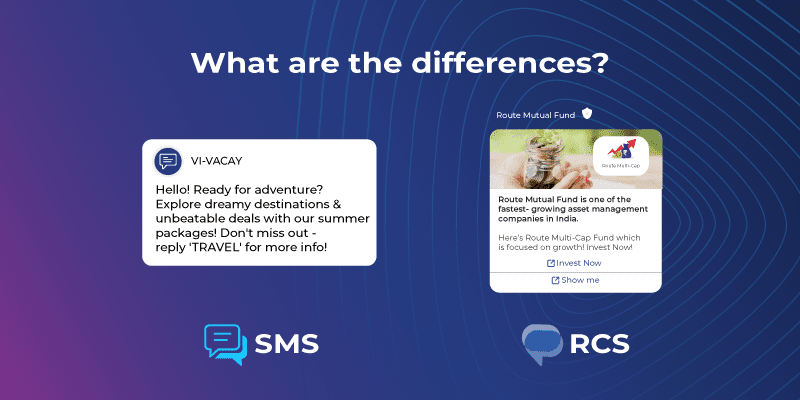
Both RCS and SMS are promising messaging channels for businesses to reach out and engage with their customers.
16 million SMS messages are sent every minute worldwide. 90% of them read their text within 3 minutes of delivery. RCS, on the other hand, has gained popularity with its rich messaging features since its launch in 2008.
Both continue to prove to be effective communication channels. Businesses without any clarity on what these services have to offer, what the difference between the two is, and whether to choose one or both will most probably lose out on both opportunities.
This article solves that for you! We dive deep into comparing the differences between RCS and SMS for business communication.
What Is RCS?
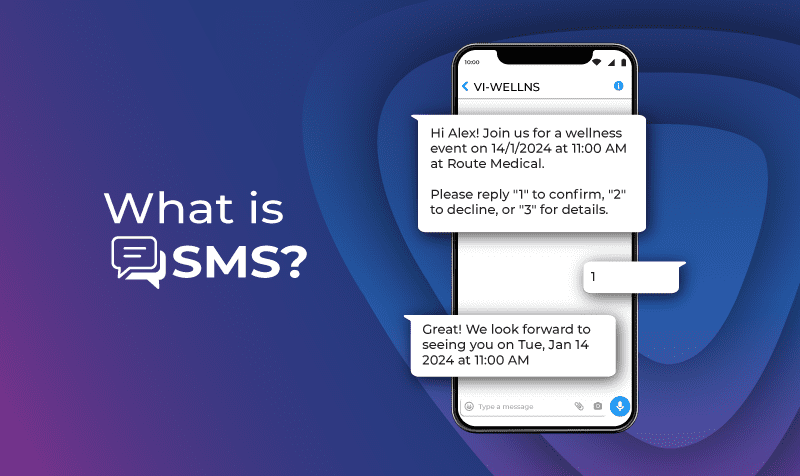
SMS stands for Short Messaging Service. It is a messaging protocol for sending and receiving short text messages over the mobile carrier network.
SMS supports short text-based communication, traditionally limited to 160 characters per message, making it ideal for OTPs, delivery notifications, banking alerts, appointment reminders, and other time-sensitive business communication.
SMS does not require an internet connection, data plan, or any additional application to download. Telecom carriers may charge for every SMS sent, where receiving is free.
This is a traditional form of text messaging introduced back in the 1990s, and since then, it has been widely popular due to its simplicity, ease of use, and reliability.
Key Features Of RCS
- Real-time messaging/marketing channel
- Send bulk SMS
- Targeted and personalised communication
- API integration
- Two-way messaging
- Highly scalable
- Dedicated virtual number ( like shortcode or 10DLC)
Benefits of RCS
Here’s what is best about RCS:
- The most convenient and fastest method to reach out to the audience
- Simplicity and efficiency make it a universal communication channel
- Access to a large audience, basically everyone with a mobile phone
- Boast high open rates and customer engagement
- Highly cost-effective and low-complexity solution
- Offer much better personalisation for SMS marketing
Must Read: RCS Business Messaging And The Benefits Of Rich Media
What Is SMS?
RCS (Rich Communication Services) is the next-generation IP-based messaging protocol that is an upgraded version of SMS by providing richer media, more interactivity, and an optimal user experience.
Unlike OTT apps such as WhatsApp, Facebook Messenger, or iMessage, RCS does not require users to download a separate application. It works directly inside the phone’s default messaging app. It allows businesses to create app-like customer experiences with much lower friction.
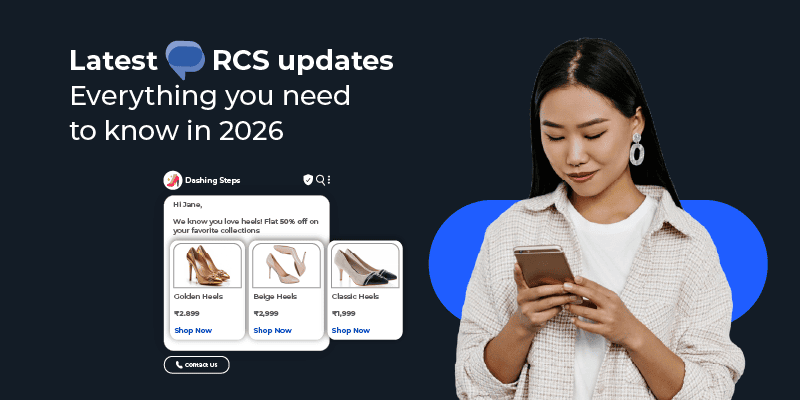
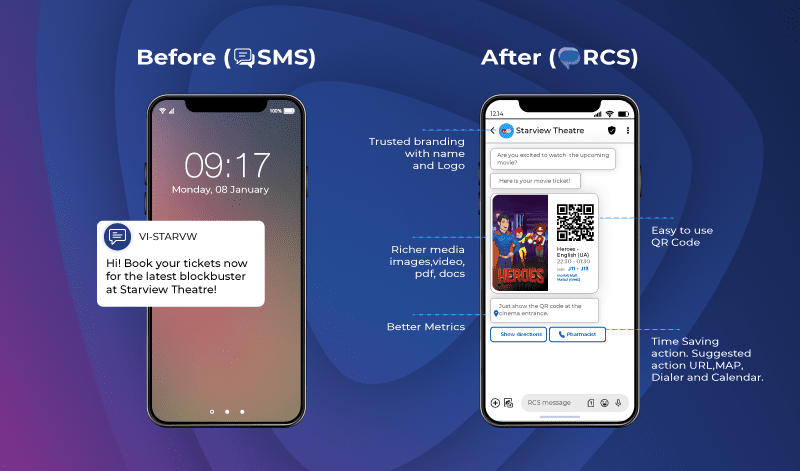
Compared to SMS, RCS supports images, videos, and suggested replies in the native messaging app. It facilitates more advanced features such as rich cards, branded interactions, and carousels.
The global RCS messaging market is expected to hit a valuation of $8.5 billion by 2031 with a CAGR of 16%.
The service is provided by the operator networks, often used for both Application-to-Person (A2P) and Person-to-Person (P2P) communication.
For A2P communication, RCS, formally known as RCS Business Messaging (RBM), is a service provided by top reputed cloud-communication service providers like Route Mobile.
Key Features Of SMS
- Support rich media content
- Encrypted messages for privacy and security
- Verified sender
- Visually appealing rich media cards
- Branded messages
- Suggested replies for better conversion
- Advanced analytics
- Search to RCS
Benefits of SMS
Here’s what’s best about SMS:
- Send rich and interactive media to enhance customer experience and increase customer engagement
- Measure transactions to analyse marketing campaigns
- Ability to target a specific group for more personalised communication
- Can directly interact with the customer’s native messaging application
- No delay in message deliverability
- Enables verified branded messaging experiences with higher trust and stronger click-through potential
- Easier to keep customers informed about the products and services with real-time updates, alerts, confirmations, and notifications.
RCS vs SMS: Feature comparison for businesses
When comparing RCS vs SMS, the right choice often depends on business goals, audience reach, customer experience expectations, and device compatibility.
The SMS is superior in reach and reliability, whereas the RCS introduces richer interactions and branded messaging experiences that can improve engagement and conversions.
| Feature | SMS | RCS |
| Message format | Plain text only | Rich text, images, video, audio, GIFs |
| Character support | Usually 160 characters | Long-form messaging support |
| Internet requirement | No | Yes |
| Reach | Works on all mobile phones | Supported devices and enabled inboxes only |
| Branding | Limited sender identity | Verified sender, logo, brand colours |
| Read receipts | Basic delivery reports | Read receipts + typing indicators |
| Interactivity | Minimal | Buttons, suggested replies, carousels |
| Security | Carrier-grade, but limited protection | Better transport security, but not equal to E2EE OTT apps |
| Integration | Standard SMS APIs | Deep CRM, chatbot, and automation integrations |
| Fallback | Native universal fallback | Can fall back to SMS/WhatsApp if unsupported |
RCS vs SMS: Advantages and disadvantages of RCS and SMS
Advantages of RCS
RCS enables businesses to transform the native inbox into a richer engagement channel.
- Supports rich media such as images, videos, GIFs, audio, and product cards
- Read receipts and typing indicators improve conversation visibility
- Enables branded messaging with logos, verified sender identity, and company name
- Interactive features like suggested replies, buttons, and carousels improve click-through journeys
- Better engagement rates for promotional and customer experience campaigns
- Supports long-form messages, rich layouts, and structured product journeys
- Higher conversion potential for commerce, support, and lead-generation workflows
Disadvantages of RCS
Despite its richer capabilities, RCS still comes with adoption and infrastructure limitations.
- Requires mobile data or internet connectivity
- Depends on carrier adoption, Android version, and enabled inbox support
- Requires fallback planning if the recipient cannot receive RCS
- Offers stronger transport security, but is still less private than fully end-to-end encrypted OTT apps
- Often requires CPaaS or third-party messaging infrastructure for enterprise-scale deployment
Advantages of SMS
SMS remains the most dependable and universally accessible messaging channel.
- Ubiquitous support across virtually all mobile phones
- Does not require internet or data access
- Fast, lightweight, and familiar to users globally
- Reliable fallback method for OTPs, alerts, and critical notifications
- Works consistently even in low-bandwidth, roaming, or network-constrained environments
Disadvantages of SMS
The strength of SMS lies in simplicity, but that also creates clear experience limitations.
- No multimedia, rich cards, or interactive messaging features
- Limited character count of 160 characters per message
- No native read receipts or typing indicators beyond basic delivery reports
- Limited branding and sender trust capabilities
- More vulnerable to phishing, spoofing, and impersonation risks
- Lower engagement rates for promotional and commerce-led messaging journeys
Comparing RCS vs SMS in detail
Functionality
SMS allows users to send messages with a strict character limit of 160 without any media capabilities. RCS, on the other hand, supports a wide range of rich media, including images, GIFs, audio, and video.
Also, there is no character limit. RCS messages can be sent from one to many. SMS’s core functionality lies within its brief and short messages, making it highly convenient, simple, and direct for users to access.
Reach
What truly stands out about SMS is its universal reach. Since every mobile phone can receive and send SMS without any extra app or internet, every mobile phone user is a potential customer.
With RCS, businesses can leverage advanced interactivity and rich media features for high customer engagement. However, the reach for RCS is limited to devices where the RCS feature is enabled.
Delivery confirmation
The delivery confirmation capabilities you get with SMS are limited and largely depend on the network carrier’s settings. Mostly, it notifies the sender that the message has been delivered successfully.
With RCS, you get more advanced, detailed features that share more information about message delivery, such as whether they have been read.
Network dependency
With RCS messaging, users require data connectivity to transmit it. However, SMS does not need an internet connection, and thus, it is not dependent on the network.
This makes SMS a highly reliable communication channel as it increases deliverability. However, it is also essential to address the fact that internet connectivity today is readily available almost everywhere in the world.
Security
SMS messages are not encrypted or secured, leaving an opportunity for potential message interception or other security risks related to privacy. RCS, however, utilises several security components, such as Transport Layer Security for encryption and other security-based protocols.
Cost
RCS offers more features, but it also requires businesses to allocate a higher budget to establish. For small businesses, it can be challenging to meet this price point, especially those with limited budgets.
SMS, on the other hand, comes with a simple feature, a cost-effective solution for business communication.
Since the SMS service is bundled with mobile plans offered by network carriers, the integration cost is extremely low.
Integration capabilities
Since SMS uses the carrier’s cellular network to send and receive messages, integrations are limited.
However, RCS uses IP, like any other messaging application, and offers much more sophisticated integration with other services/systems, including chatbots, CRM systems, marketing automation platforms, and more.
Rich media
RCS excels in its ability to utilise rich media and interactive content. It helps businesses to create a much more engaging user experience. However, this is only possible when the sender and the recipient both have enabled the RCS feature.
With SMS, businesses can only send plain text with limited characters, and it doesn’t support rich media or interactivity. However, with SMS, businesses can be assured of its simplicity and reliability, making it universal in communication.
Read More: Will RCS Replace SMS by 2025 as the Dominant Text Message System
Business use cases: When to use SMS vs RCS
The decision between RCS vs SMS message strategies should always depend on the customer journey, the urgency of communication, device reach, and the level of interaction required.
For most enterprises, the best results come not from choosing one over the other, but from mapping each channel to the right use case.
When to use SMS?
SMS is best suited for communication that prioritises speed, reach, and guaranteed visibility. Businesses should use SMS for:
- OTP verification and authentication workflows
- Fraud alerts and account activity notifications
- Delivery, appointment, and payment reminders
- Emergency notifications and service outage alerts
- Time-sensitive transactional communication
- Global messaging campaigns where device compatibility is critical
- Regulatory notifications
- Government and public service alerts
- Password resets and account recovery
For high-priority communication, SMS remains the most reliable option because it works across virtually all mobile devices without data dependency.
When to use RCS?
RCS works best when the business objective goes beyond delivery and focuses on richer customer engagement. RCS is ideal for:
- OTP verification and authentication workflows
- Fraud alerts and account activity notifications
- Delivery, appointment, and payment reminders
- Emergency notifications and service outage alerts
- Promotional campaigns with product images, offers, and videos
- Conversational commerce journeys
- Customer support with quick replies and interactive flows
- Lead generation campaigns with CTA buttons
- Abandoned cart recovery journeys
- Loyalty, rewards, and personalised offers
- Upsell and cross-sell messaging campaigns
For businesses focused on RCS marketing vs sms marketing, RCS offers stronger engagement potential because the experience feels closer to an in-app journey.
Combining SMS and RCS in customer campaigns
The most effective business messaging strategies often combine both channels.
The best and most common approach is to use RCS for the rich primary customer experience and SMS as the fallback or universal delivery layer.
For example:
- Send a rich promotional product carousel over RCS
- Use SMS fallback if unsupported
- Send OTPs and transaction alerts over SMS
- Use RCS for post-purchase upsell and feedback journeys
This hybrid model allows businesses to balance reach, engagement, and delivery continuity.
Can RCS replace SMS in the long term?
RCS has strong long-term potential to become the richer default messaging layer for business communication, especially for marketing, commerce, and customer support use cases.
However, SMS is unlikely to disappear because its universal device compatibility, low-bandwidth reliability, and telecom-native infrastructure make it essential for critical communication.
Today, RCS is evolving less as a replacement and more as an experience upgrade layer that works alongside SMS.
RCS and SMS hybrid approach: The fallback strategy that maximizes reach
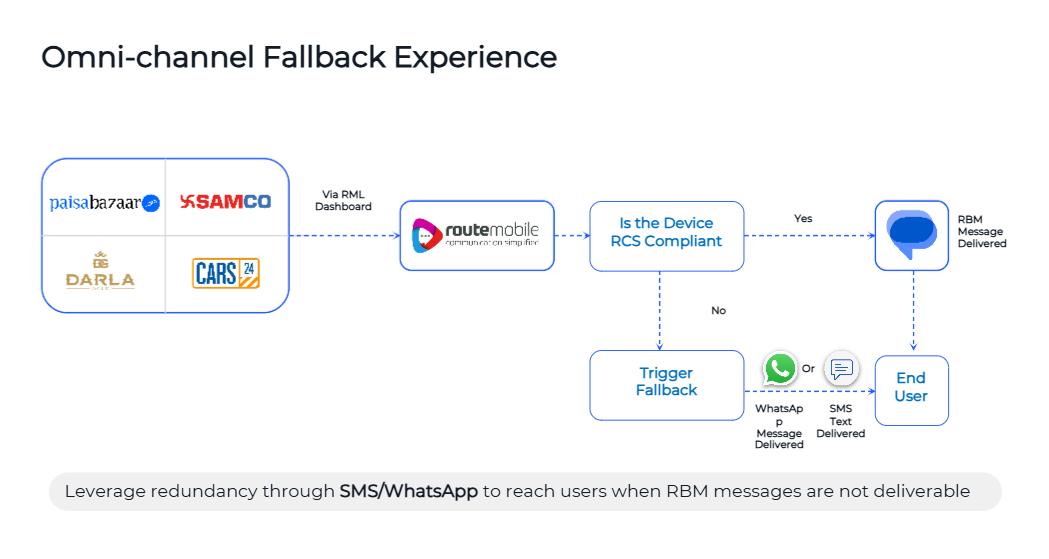
For most enterprises, the smartest messaging strategy is not choosing between SMS and RCS, but combining both in a fallback-ready communication flow.
When you go for a hybrid strategy, it allows businesses to send the best possible customer experience through RCS first, while automatically falling back to SMS when the recipient’s device, carrier, or inbox does not support rich messaging.
This ensures that every message still reaches the customer, regardless of compatibility limitations.
How does the RCS-to-SMS fallback flow work?
This model helps maintain customer journey continuity while preserving campaign performance. The workflow is simple and highly effective.
- The business sends the primary message as RCS with rich cards, buttons, media, or branded elements.
- The platform checks whether the recipient device supports RCS
- If supported, the customer receives the full rich messaging experience
- If unsupported, the same communication is automatically delivered as SMS
- The customer still receives the core message without interruption
Best business use cases for hybrid messaging
This approach is particularly useful for enterprises operating across markets with varying Android adoption, carrier support, and device diversity.
The hybrid RCS and SMS approach is especially effective for the following business applications:
- OTP and authentication flows where delivery certainty is critical
- Promotional campaigns that need both rich engagement and universal reach
- Delivery and order notifications with rich tracking links
- Appointment reminders with quick response buttons
- Customer support escalations and resolution updates
- Cart recovery and post-purchase journeys
- Cross-border campaigns with mixed device ecosystems
Conclusion
SMS and RCS both have their distinct characteristics and strengths for business. They are not mutually exclusive but rather complementary to each other.
Companies must focus on leveraging both communication channels for their strength, i.e., simplicity, reliability, and wide adoption of SMS and rich media features and interactivity capabilities with RCS.
Businesses must expect high user engagement, improved customer satisfaction, and dynamic messaging when choosing RCS.
With SMS, they are opting for a legacy channel with extraordinary open rates, reach, and deliverability, catering to an even larger audience.
Consult a reputable business services provider like Route Mobile, a leading cloud communication platform-as-a-service brand offering SMS and RCS messaging services. Contact our experts to guide you further!
FAQs
What’s the difference between RCS and SMS messaging?
SMS is a traditional messaging method offering the simplest, most reliable, and most convenient way to communicate, sending simple text messages. In contrast, RCS offers advanced messaging features, such as rich media and interactivity, to boost customer engagement.
How do businesses send RCS messages to their customers?
Businesses can send RCS messages to their customers by choosing a messaging platform or by collaborating with a communication platform-as-a-service (CPaaS) provider. They provide companies with the infrastructure needed to send and manage messages at scale.
What businesses should choose between RCS and SMS?
RCS and SMS are not mutually exclusive; they are complementary to each other when used within a strategic business communication/marketing campaign. Enterprises must leverage both channels to achieve maximum customer engagement and an omnichannel presence.
Which businesses should choose RCS vs SMS?
Businesses should choose SMS when message delivery speed, universal reach, and low-friction communication are the priority. This includes industries such as banking, logistics, healthcare, travel, and fintech, where alerts, OTPs, and reminders are business-critical. RCS is better suited for ecommerce, retail, travel, hospitality, telecom, and customer engagement-led brands that want richer promotional campaigns, branded messaging, and interactive commerce experiences. For most enterprises, the strongest strategy combines both.
Does RCS cost more than SMS for businesses?
In most cases, yes. RCS usually involves higher setup and campaign costs than SMS because it supports rich media, branded templates, analytics, interactivity, and deeper platform integrations. However, businesses often justify the higher cost by citing improved engagement, higher click-through rates, stronger customer trust, and higher conversion rates.
Is RCS reliable for large-scale campaigns?
Yes, RCS can be highly effective for large-scale business campaigns, especially when used for promotions, customer journeys, support, and conversational commerce. However, reliability depends on device compatibility, carrier support, Android adoption, and whether fallback logic is implemented. This is why many enterprises combine RCS with SMS fallback to ensure campaign continuity across all customer devices.